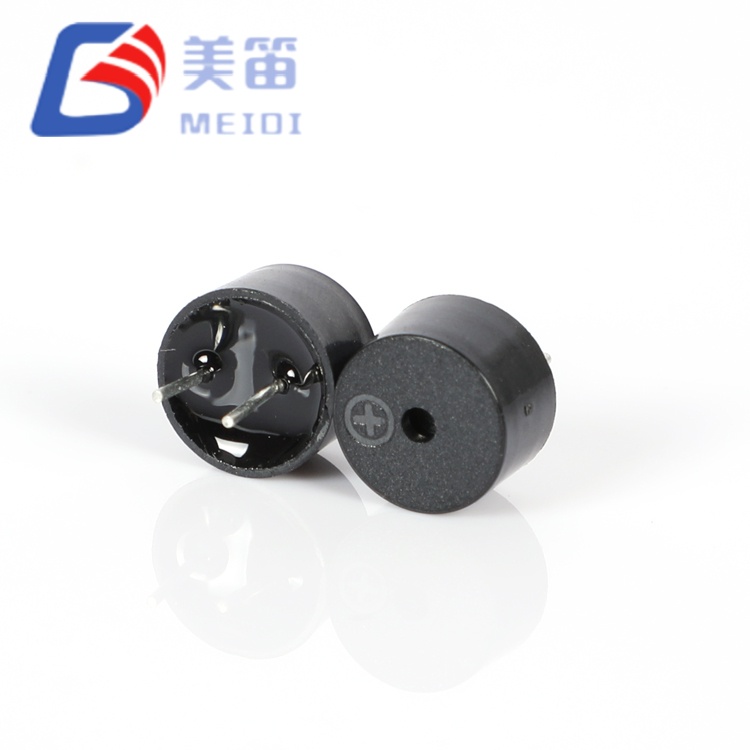
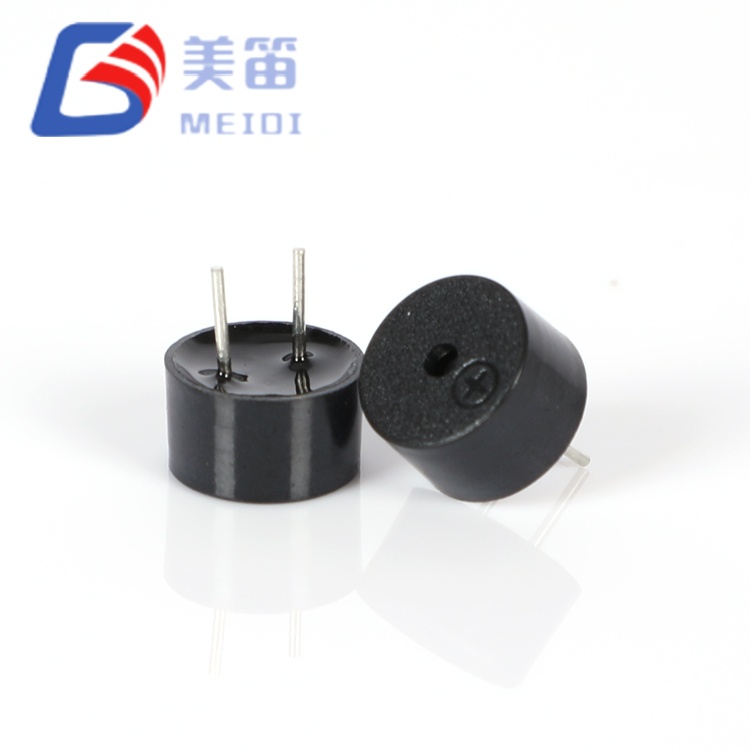
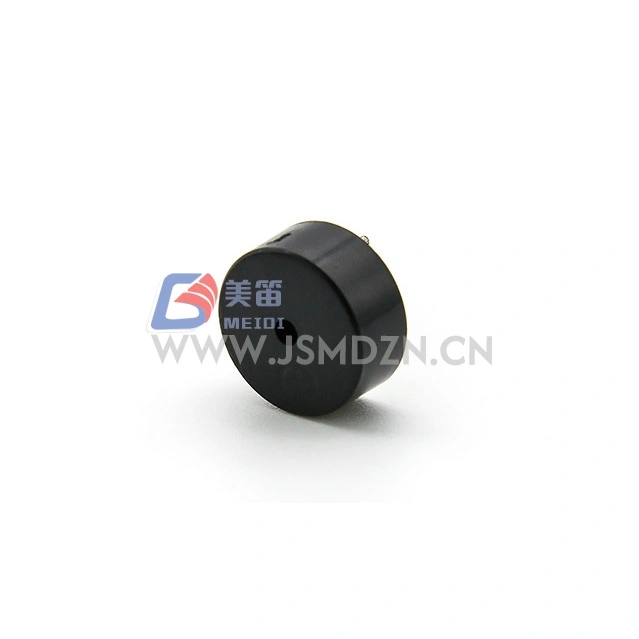
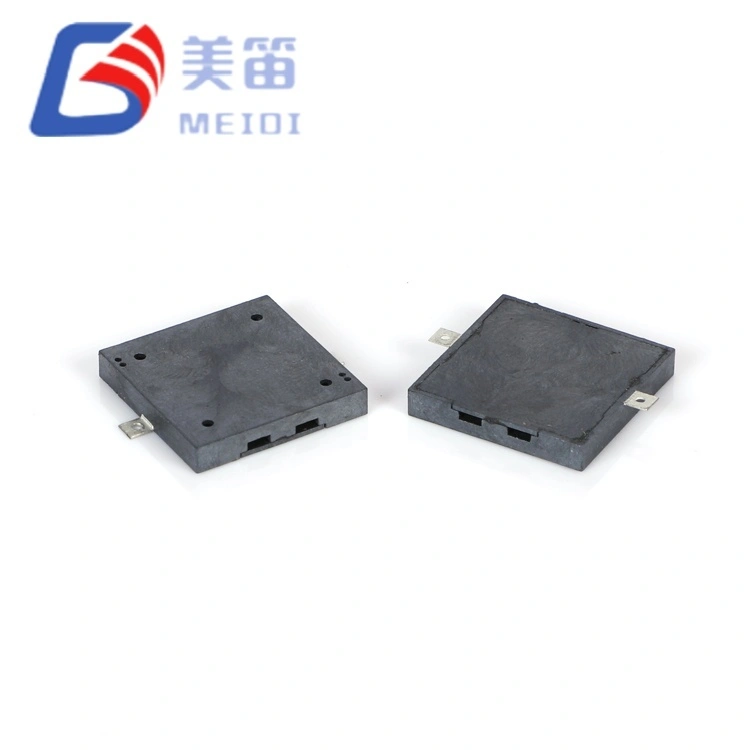
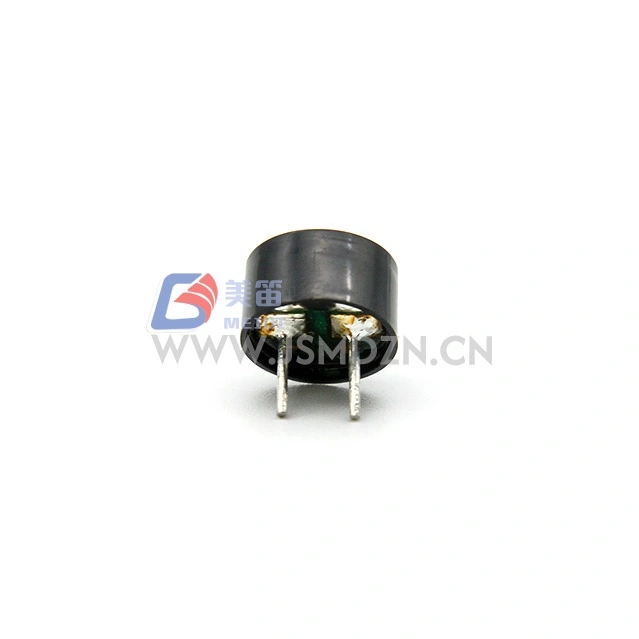
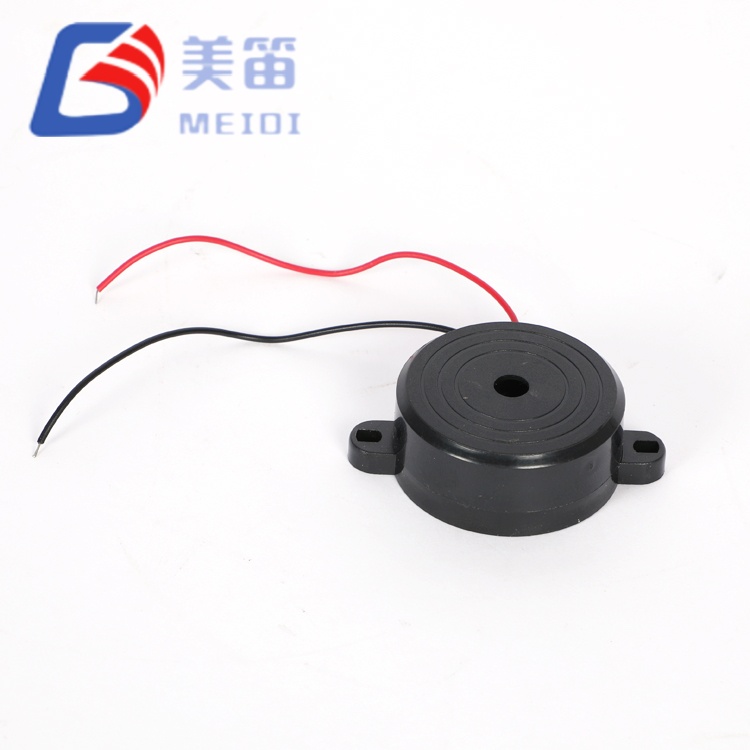
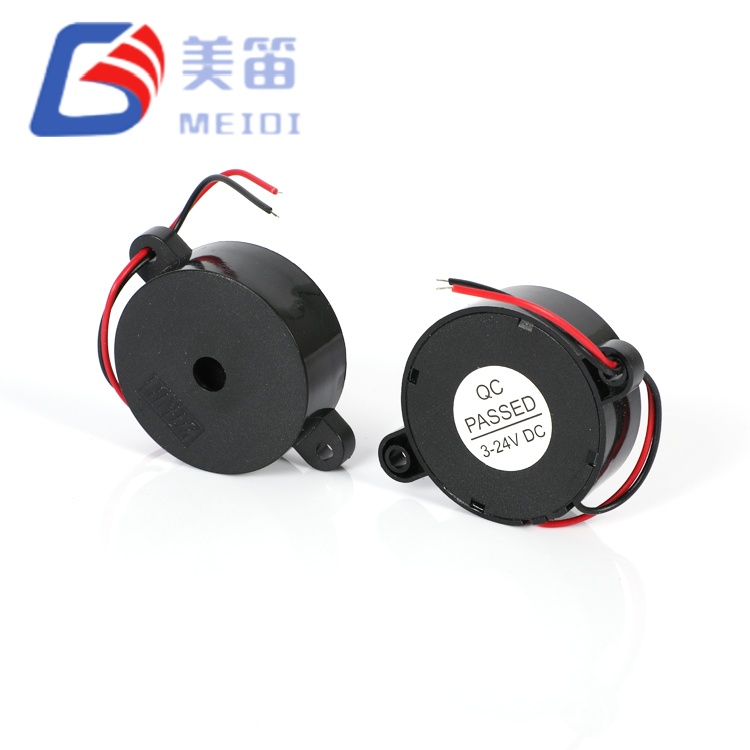
In short: an active piezoelectric buzzer carries its own oscillator, so plain DC power is all it needs to produce a finished alert tone. This 2026 guide explains how an active piezoelectric buzzer works, how it differs from a passive one, why it improves modern electronic alert systems, where it is used, and how to select the right model — with real specifications drawn from the MEIDI production catalog.
1. What Is an Active Piezoelectric Buzzer?
An active piezoelectric buzzer is a sound component that uses the piezoelectric effect to generate an audible signal, and it contains a built-in oscillator circuit. Unlike a passive type, which waits for an external square-wave signal to decide the pitch, an active piezoelectric buzzer only asks for DC voltage inside its rated range. Connect the two terminals of an active piezoelectric buzzer to power and the tone starts on its own.
That single property is why the active piezoelectric buzzer has become the default alert component across so many product categories. Designers do not have to write tone-generation code, add an oscillator IC, or tune a drive circuit. The PCB layout stays simpler, development moves faster, and the emitted sound is identical on every unit that leaves the production line. That consistency is a big reason the active piezoelectric buzzer is so widely adopted.
Modern electronic equipment also rewards components that are small, thin, and quiet in terms of power draw. A typical active piezoelectric buzzer draws only a few milliamps, survives wide temperature ranges, and keeps working for years inside sealed enclosures. Those traits line up exactly with what an electronic alert system needs.
2. Active vs Passive Piezoelectric Buzzer
The fastest way to understand an active piezoelectric buzzer is to set it against its passive sibling. Both rely on the same ceramic and diaphragm, but they differ in who supplies the alternating signal that drives an active piezoelectric buzzer.
Aspect
Active Piezoelectric Buzzer
Passive Piezoelectric Buzzer
Drive signal
Internal oscillator, DC only
External square wave from MCU or driver
Tone options
Fixed single tone
Any frequency you generate
Software effort
None
Requires tone code and PWM timing
BOM and PCB area
Fewer parts, smaller footprint
Needs driver components
Best fit
Alarms, warnings, status beeps
Melodies, chimes, voice-like cues
For an alarm or a status beep, an active piezoelectric buzzer is almost always the cheaper and more reliable choice because the tone is fixed at the factory. A passive element only wins when the product must play more than one pitch. When the brief is “make a loud, repeatable warning,” the active piezoelectric buzzer is the part to specify.
3. How Does an Active Piezoelectric Buzzer Work?
The working principle of an active piezoelectric buzzer combines one physical effect with one small circuit. Understanding both makes specification decisions for an active piezoelectric buzzer much easier.
3.1 The Piezoelectric Effect
Certain ceramic materials deform mechanically when a voltage is applied across them. Inside an active piezoelectric buzzer, a piezoelectric ceramic element is bonded to a metal diaphragm. When the driving signal alternates, the ceramic flexes thousands of times per second, and the diaphragm pushes air to create the tone an active piezoelectric buzzer is built to make. Because the moving mass is microscopic, the conversion is efficient and the current consumption stays low.
3.2 The Built-In Oscillator
The oscillator is what makes the part “active.” It converts the steady DC supply into an alternating signal at a designed frequency, then drives the ceramic element at that frequency. Because the frequency is fixed inside the part, every active piezoelectric buzzer produces the same consistent tone without any external control — which is exactly what a warning signal should do: sound the same every single time. The drive circuit is therefore trivial: one resistor to limit inrush, and the active piezoelectric buzzer does the rest.
3.3 Inside the Housing
Component
Function
Piezoelectric ceramic element
Converts electrical energy into mechanical vibration.
Oscillator circuit
Generates the driving frequency automatically from the DC input.
Resonance chamber
Improves sound radiation and acoustic efficiency.
Housing (ABS or PPS)
Protects the internals, sets the mounting style, and focuses the sound.
Because the tone is handled internally, integration is genuinely simple: the active piezoelectric buzzer behaves like a two-terminal component that turns power into sound.
4. How Does an Active Piezoelectric Buzzer Improve Modern Electronic Alert Systems?
This is the core of the question for any active piezoelectric buzzer, and it comes down to five concrete improvements over older or improvised alert solutions.
Alert System Challenge
How an Active Piezoelectric Buzzer Solves It
Extra drive circuitry adds cost and failure points
The built-in oscillator removes external frequency components entirely.
Limited board space in compact devices
A thin, compact housing fits dense PCBs and small enclosures.
Power budget in battery and standby circuits
Milliamp-level current keeps the alert almost free in energy terms.
Inconsistent alarm loudness between units
A fixed internal frequency delivers repeatable SPL unit after unit.
Assembly complexity on the production line
A simple DC connection reduces assembly steps and test time.
There is also a reliability argument. An active piezoelectric buzzer has no coil to burn and no moving contact to wear, so the alert keeps working after thousands of cycles. For safety-related equipment, that endurance is often the difference between a compliant product and an expensive warranty claim. In 2026, as more devices ship battery-backed and sealed for harsh sites, the active piezoelectric buzzer fits the trend better than ever.
5. Where Are Active Piezoelectric Buzzers Used?
The active piezoelectric buzzer appears wherever an electronic product must tell a human something urgent:
Industrial control equipment — machine status notification, fault warnings, and emergency-stop alarms on 12 V and 24 V systems.
Medical equipment — patient monitors and infusion devices where a clear, immediate tone matters.
Security systems — access-control panels, detectors, and siren modules.
Household appliances — microwave ovens, washing machines, and smart-home devices.
Power equipment — UPS units, chargers, and electrical monitoring products.
Across all of these, the common thread is the same: the alert must sound immediately, sound the same every time, and never be the reason the product fails. That is precisely the design brief an active piezoelectric buzzer was built for, and why it keeps displacing older electromagnetic alarms in new designs.
6. How to Select the Right Active Piezoelectric Buzzer
Choosing the correct active piezoelectric buzzer is a four-step narrowing process.
6.1 Match the Supply Voltage
Start from the power rail. Small consumer boards usually run 3–5 V parts, industrial control runs 12 V, and heavy equipment often needs 24 V. MEIDI produces active piezoelectric buzzer models across 5 V, 6 V, 12 V, 24 V, and even 220 V AC input, so most rails are covered by an active piezoelectric buzzer without a custom build. Never run a part above its rated voltage for long periods; the ceramic and the oscillator both age faster.
6.2 Check SPL at the Rated Frequency
Sound pressure level is quoted in dB at a fixed distance and at the part’s designed frequency. For a machine alarm you typically want 90 dB or more; for a household device, 80–85 dB is usually enough. When you compare datasheets, compare SPL at the same distance, and remember that driving an active piezoelectric buzzer below its rated voltage reduces loudness.
6.3 Choose the Mounting Style
Through-hole pins suit manual assembly and wire connectors; lead-wire types suit remote mounting inside an enclosure; and panel-mount cases suit exposed alarm points. When the board is crowded, an SMD active piezoelectric buzzer keeps the speaker off the height budget and suits high-volume automated lines. For dense boards, an SMD active piezoelectric buzzer is often the only speaker that fits the envelope. Picking the package early avoids a late redesign and keeps the active piezoelectric buzzer in its intended acoustic environment.
6.4 Verify the Environment and Compliance
Check the operating temperature span against the real product environment — outdoor and automotive-adjacent gear needs more margin than office equipment. For substance compliance, confirm RoHS and REACH. MEIDI manufactures under ISO 9001 and ISO 14001 systems, so documentation travels with every active piezoelectric buzzer shipment.
7. Real MEIDI Active Piezoelectric Buzzer Models (2026)
The table below lists real MEIDI active piezo models with catalog specifications. Each active piezoelectric buzzer is a stocked production item rather than a custom build, which keeps lead time predictable.
Model
Rated Voltage
Resonant Freq.
SPL (min)
Current
Dimensions
Temp. Range
HND-1407B
5 V DC
4500±500 Hz
≥85 dB
5 mA
14×7 mm
−30~+70 °C
HND-2310B
12 V DC
3500±500 Hz
≥85 dB
12 mA
22.8×9.8 mm
−20~+75 °C
HND-2316
12 V DC
3000±500 Hz
≥90 dB
12 mA
23×16 mm
−20~+80 °C
HND-2319
12 V DC
3700±500 Hz
≥90 dB
12 mA
23×19 mm
−20~+80 °C
HND-2616
12 V DC
2800±500 Hz
≥85 dB
12 mA
25.6×16 mm
−30~+85 °C
HND-3015A-6V
6 V DC
3400 Hz
≥85 dB
6 mA
30×15 mm
−20~+80 °C
HND-3015A-12V
12 V DC
3300 Hz
≥88 dB
12 mA
30×15 mm
−20~+80 °C
HND-3015A-24V
24 V DC
3100 Hz
≥90 dB
24 mA
30×15 mm
−20~+80 °C
HND-3025
24 V DC
3500±500 Hz
≥105 dB
24 mA
30×25 mm
−20~+70 °C
HND-4216
12 V DC
2800±500 Hz
≥90 dB
12 mA
41.8×16 mm
−20~+80 °C
BJ-3
220 V AC
2500±500 Hz
≥105 dB
220 mA
54×53 mm
−20~+60 °C
This range shows why an active piezoelectric buzzer fits so many designs: voltages span 5 V to 220 V, SPL spans 85 dB to 105 dB, and the temperature span reaches −30 °C on the low end for cold-storage and outdoor use. For a quick prototype, this breadth means an active piezoelectric buzzer is almost always on the shortlist.
8. Frequently Asked Questions
8.1 Can an active piezoelectric buzzer play a melody?
No. The internal oscillator fixes the frequency, so the part emits one tone. If you need a melody or a two-tone chime, choose a passive piezoelectric element driven by a microcontroller instead of an active piezoelectric buzzer.
8.2 Is an active piezoelectric buzzer polarized?
Most DC active piezoelectric buzzer types are polarity-sensitive and must be connected with the correct positive and negative lead. Reversing them usually means no sound rather than damage, but always follow the datasheet. AC-input types such as the BJ-3 do not have a polarity concern.
8.3 Can I drive an active piezoelectric buzzer with PWM?
You do not need to. The whole point of an active piezoelectric buzzer is that it makes its own tone from steady DC, so a plain regulated supply or a GPIO through a resistor is enough. Applying an external PWM can distort or silence the part. If you want PWM control of pitch, switch to a passive element.
8.4 How loud is an active piezoelectric buzzer compared with an electromagnetic one?
At the same supply, a well-chosen active piezoelectric buzzer reaches 85–105 dB, which is comparable to many electromagnetic buzzers but at a fraction of the current. The piezoelectric type also tends to outlast a coil part in humid or vibrating environments.
8.5 What is the typical service life?
Because there is no coil or contact to wear, the limiting factor of an active piezoelectric buzzer is the ceramic and the seal. In normal indoor conditions an active piezoelectric buzzer runs for tens of thousands of operating hours, which is why it is trusted in safety and medical gear.
8.6 Do you provide samples and full specifications?
Yes. MEIDI ships samples of every listed active piezoelectric buzzer model and provides the full datasheet, RoHS/REACH evidence, and ISO 9001 / ISO 14001 documentation on request. Lead time varies by season, so confirm it at the enquiry stage.
Follow MEIDI for buzzer engineering notes
LinkedInHaya Liu on LinkedIn — application notes, buzzer selection guides and factory updates.
FacebookMEIDI Buzzer on Facebook — buzzer product videos, production line clips and new model releases.
We use cookies to offer you a better browsing experience, analyze site traffic and personalize content. By using this site, you agree to our use of cookies. Privacy Policy