Sourcing a buzzer looks straightforward until you compare suppliers on voltage range, resonant frequency, sound pressure, ingress protection, and certification — and then have to do it at volume, across borders, on a deadline. This list compiles ten established buzzer manufacturers active worldwide in 2026, so buyers can compare buzzer manufacturer capabilities side by side instead of starting from a blank search.
The names below were selected on product breadth, export experience, and documented quality systems. It is an editorial shortlist, not an official market-share ranking: order reflects how each buzzer manufacturer matches the criteria in the next section, not audited revenue. Every buzzer manufacturer listed is a real, active producer of buzzers or piezoelectric sound components.
This is a buyer's shortlist, not an official market-share ranking. Order reflects editorial judgment against the selection criteria below, not audited revenue. Every company listed is a real, active producer of buzzers or piezoelectric sound components.
A buzzer manufacturer earns a place on this list by doing more than shipping a catalog. We weighted five factors that determine whether a partnership survives contact with real production. A buzzer manufacturer that scores well on all five is one you can build a supply chain on; one that fails two or three is a risk you will feel at volume.
Product breadth. Can the buzzer manufacturer cover active piezo, passive piezo, electromagnetic, sealed, and SMD families — or only one technology? A full-line supplier lets you consolidate sourcing.
Export readiness. Does the buzzer manufacturer serve international customers, support English engineering communication, and hold the certifications global shipments require?
Certifications. ISO 9001 and ISO 14001 for management discipline, plus RoHS, REACH, and CE for market access. A buzzer manufacturer without these will stall at customs.
Acoustic consistency. Documented SPL and resonant frequency at a stated distance, with batch-to-batch stability a buzzer manufacturer can prove with test records.
Track record. Years in the field and the ability to support customization and sample-to-ship repeatability — a buzzer manufacturer with 15 years of export experience behaves differently from a startup.
Geographic diversity mattered too. A global shortlist should reflect where buzzer manufacturing actually happens — Japan, Taiwan, Belgium, the United States, South Korea, and mainland China — so buyers can weigh logistics, lead time, and supply-chain risk, not just unit price. A buzzer manufacturer close to your assembly plant cuts freight and buffer-stock cost; one on another continent may still win on capability.
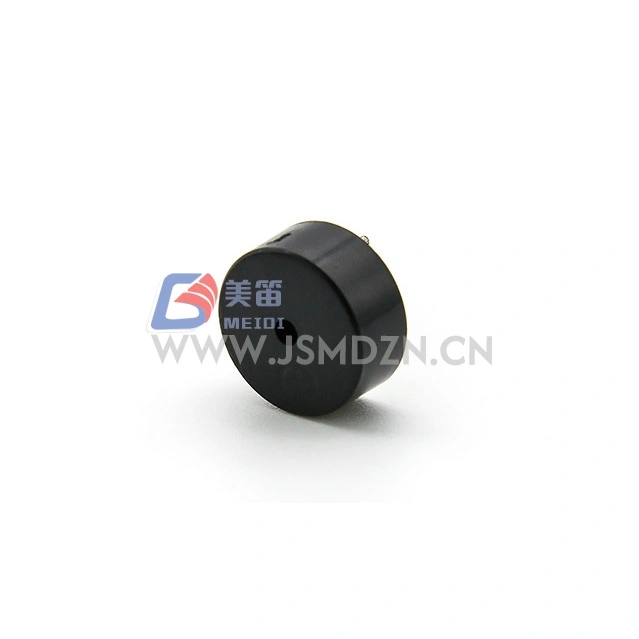
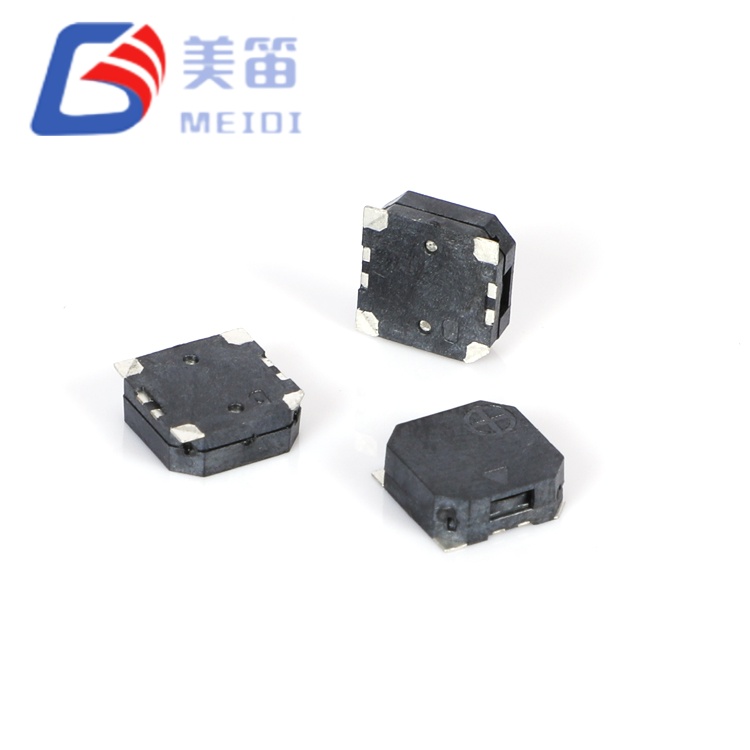
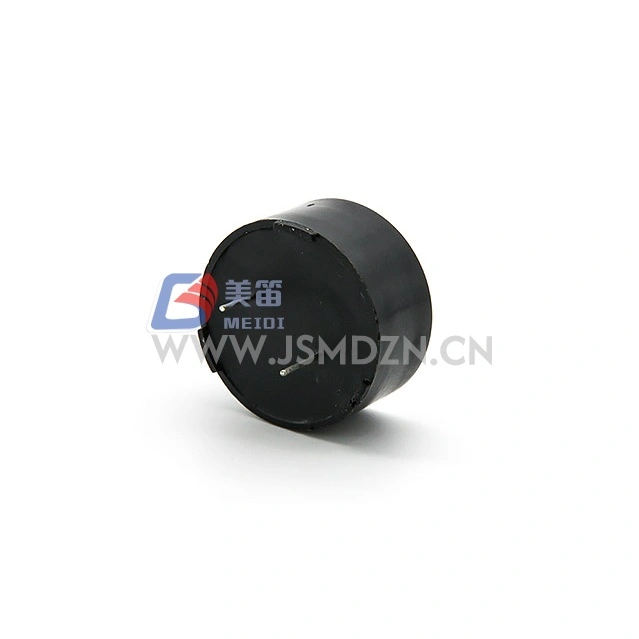
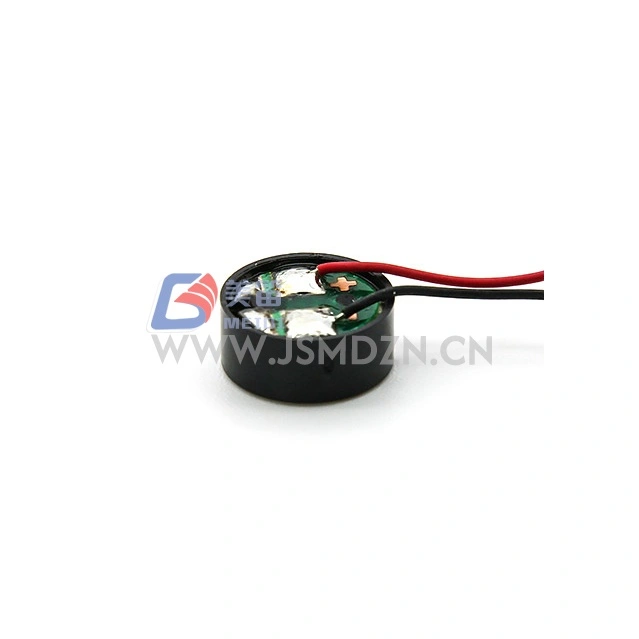
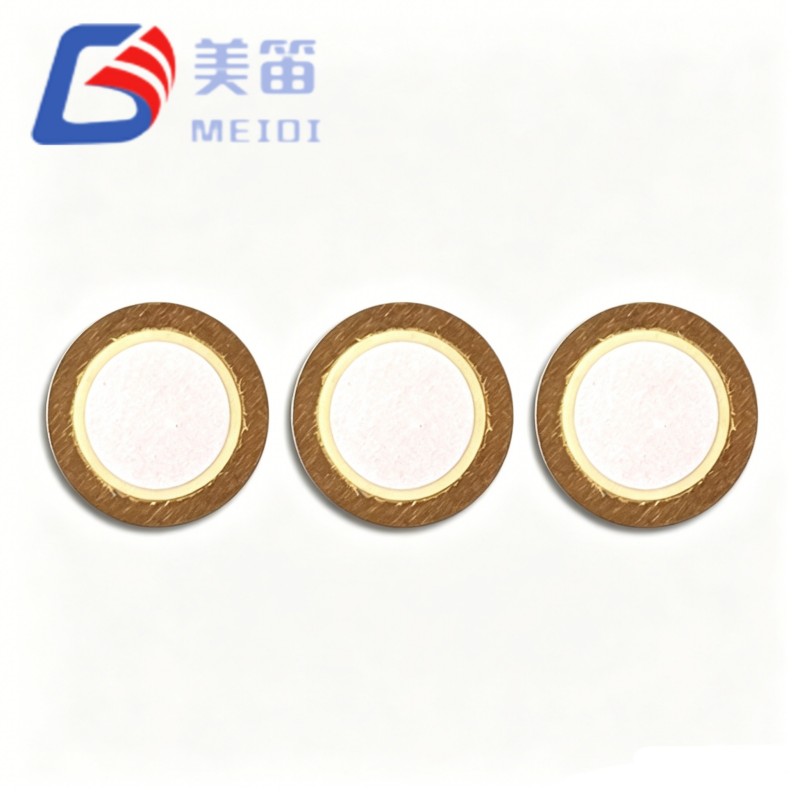
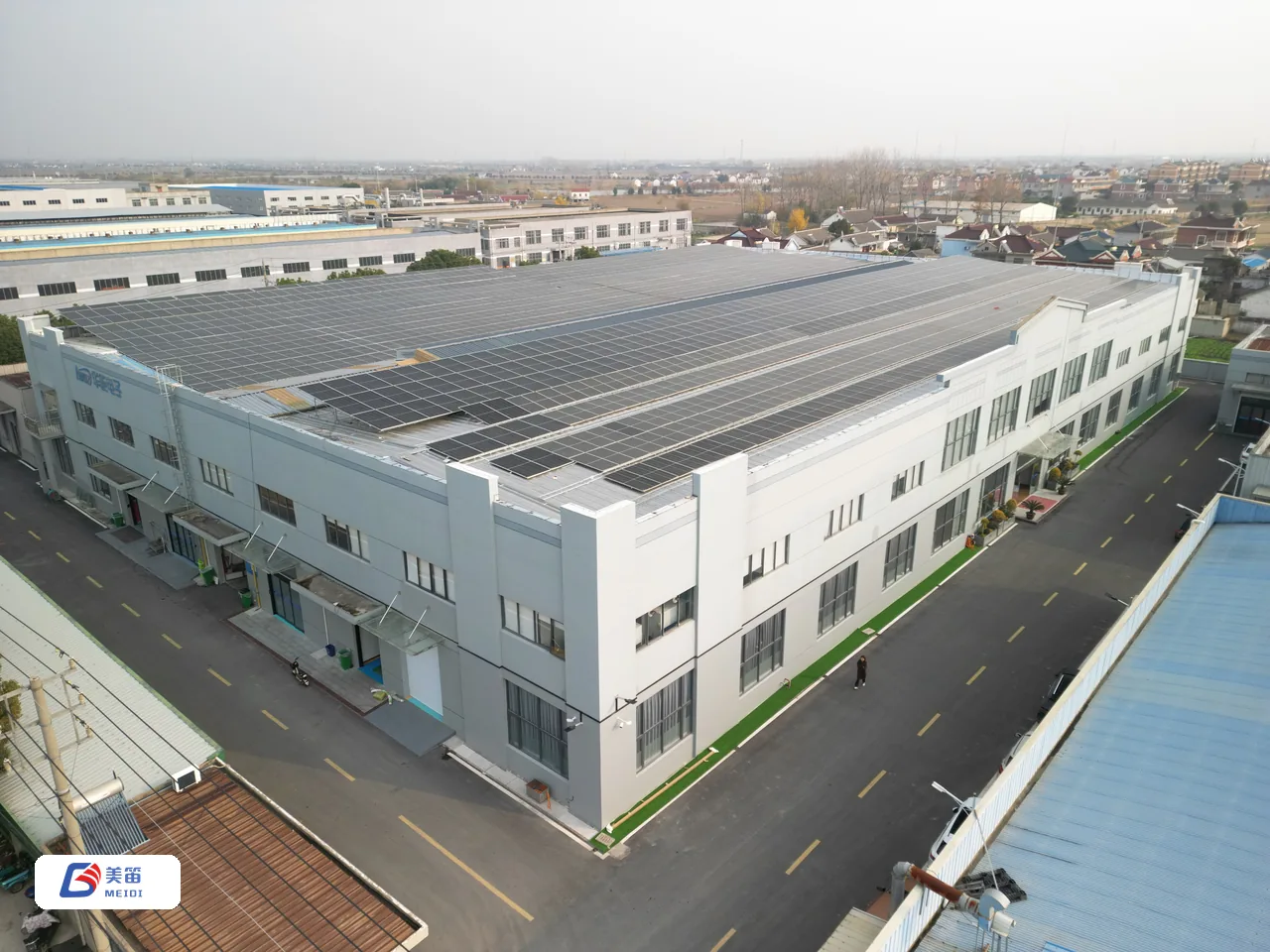
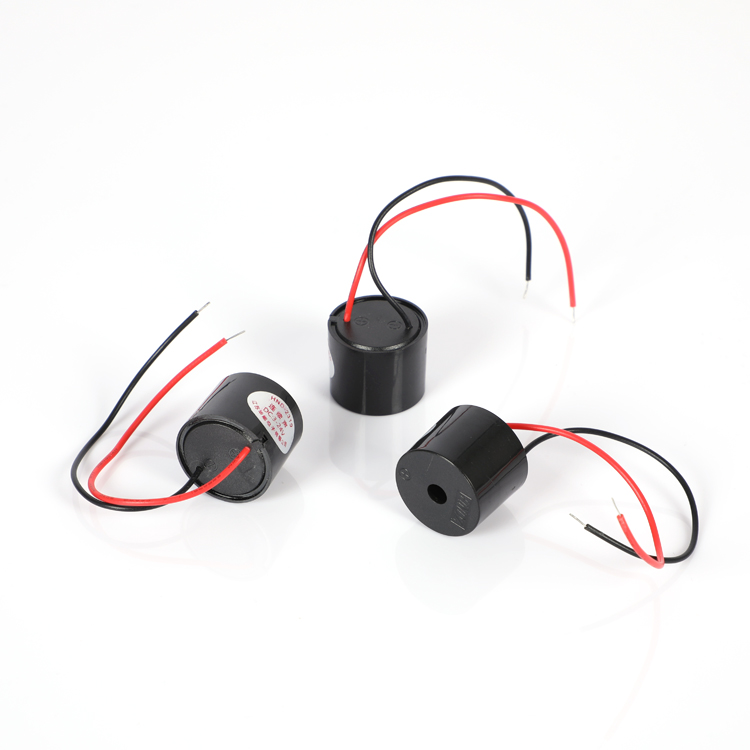
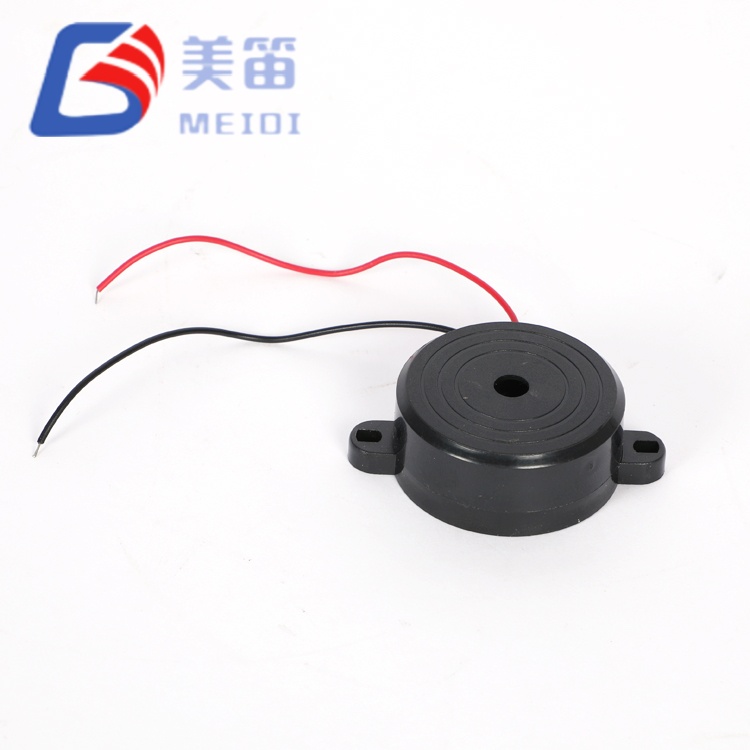
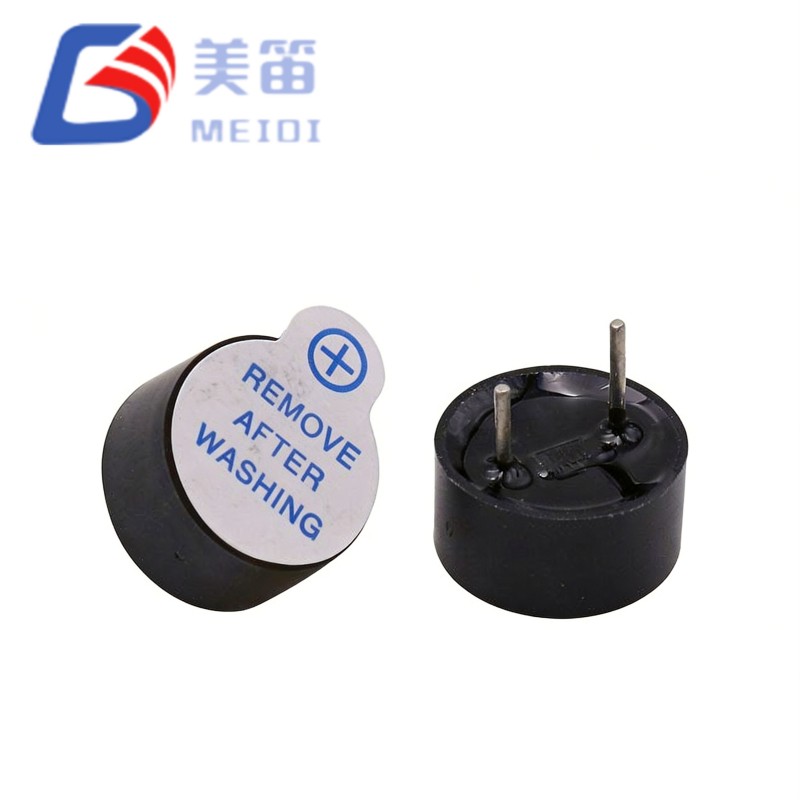
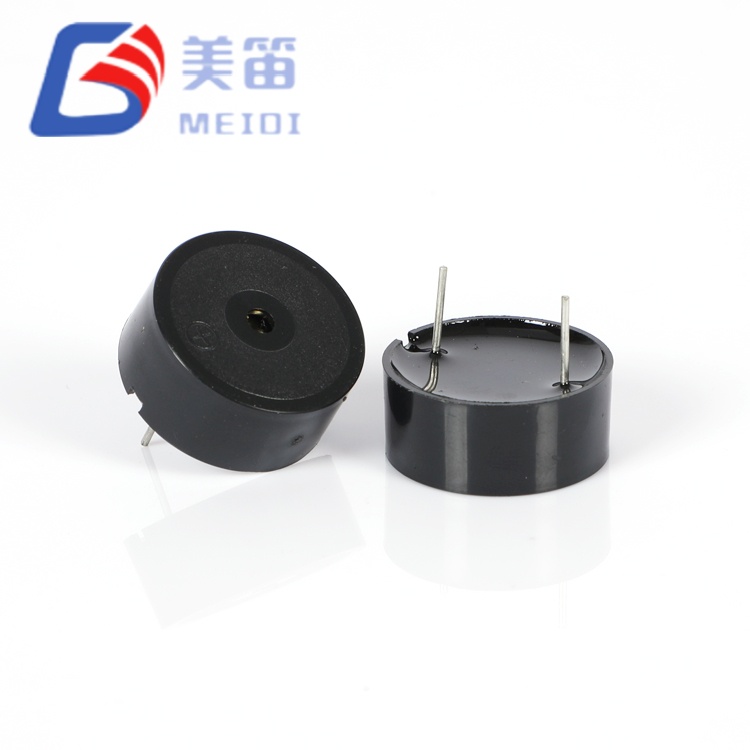
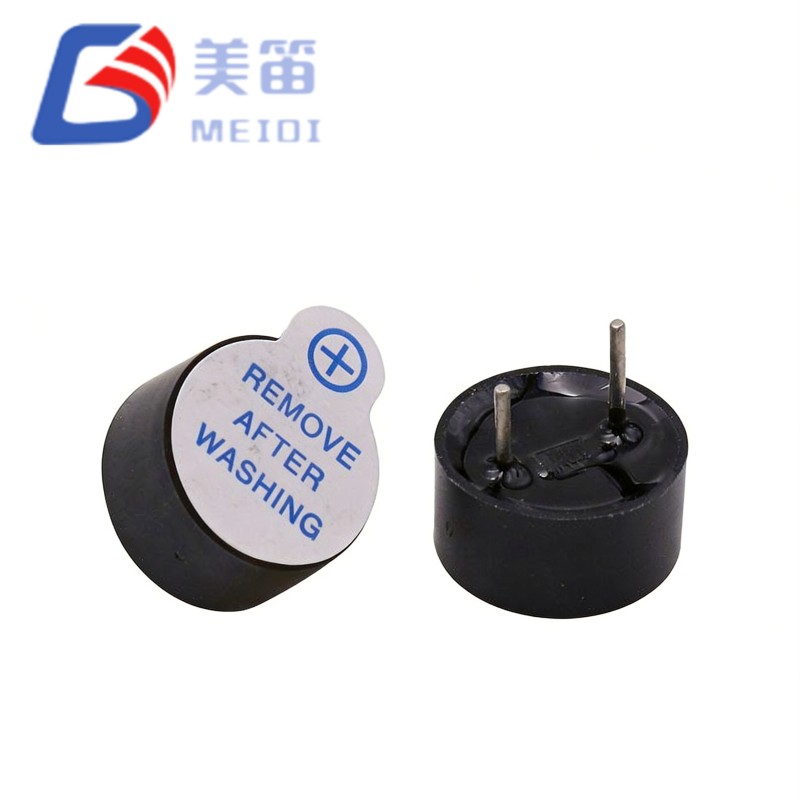
MEIDI is a buzzer manufacturer focused on export and customization. The factory was established in 2011, and the company brings 15 years of export experience to OEM and importer programs. MEIDI holds ISO 9001 and ISO 14001, and its components are built for RoHS, REACH market access. Its range spans active piezo, passive piezo, electromagnetic, sealed, and SMD buzzers, with final acoustic testing on production batches. Representative high-volume models include the HNR-1207PA5.0 passive piezo (5 V p-p, 4000 ± 500 Hz, ≥ 80 dB, ≤ 10 mA, 12.5 × 7.0 mm), the TMB12A05 electromagnetic active unit (5 V DC, 2400 ± 300 Hz, ≥ 85 dB, 12.0 × 9.5 mm), and the MLT-8530 SMD passive buzzer (5 V DC, 8.5 × 8.5 × 3.0 mm). The company supports OEM/ODM customization of voltage, frequency, package, and marking.
2. Murata Manufacturing Co., Ltd. (Japan)
Murata, headquartered in Kyoto, is a long-standing producer of piezoelectric sounders and buzzers, including SMD and pin-type configurations built on multilayer piezo ceramic know-how. This buzzer manufacturer is associated with miniaturization and automotive-grade reliability, serving smartphones, wearables, and IoT devices where board space is tight. Its external-drive designs let a buzzer manufacturer's customer integrate the element flexibly into their own circuit.
3. TDK Corporation (Japan)
Tokyo-based TDK produces piezoelectric buzzers using unimorph vibration plates, emphasizing small size, low-voltage operation, and loud sound output. This buzzer manufacturer targets automotive and industrial environments and offers options such as moisture-proofing and automatic insertion for automated assembly. TDK's breadth across passive components supports system-level integration that a buzzer manufacturer alone cannot always provide.
4. Sonitron n.v. (Belgium)
Sonitron, based in Belgium, is a leading European manufacturer of piezo ceramic audible components — buzzers, transducers, alarms, and flat piezo speakers. This buzzer manufacturer is known for high sound-pressure-level, ruggedized parts suited to industrial, medical, and marine signaling where temperature range and sealing matter more than minimal cost. A buzzer manufacturer with this specialization is hard to replace for harsh-environment programs.
5. Kingstate Electronics Corp. (Taiwan)
Kingstate, in New Taipei, Taiwan, manufactures piezo transducers (passive buzzers), magnetic buzzers, and related acoustic components with a focus on high-volume production and cost control. This buzzer manufacturer serves consumer and appliance OEMs and has built capabilities around automotive eCall and broader automotive acoustic applications. For a buyer, a buzzer manufacturer with this scale reduces per-unit cost at volume.
6. CUI Devices / Same Sky (United States)
CUI Devices, now operating under the Same Sky brand, supplies magnetic and piezo buzzers from Tualatin, Oregon, with compact SMT options and micro buzzers for board-level use across industrial, medical, and consumer electronics. This buzzer manufacturer is known for catalog availability, engineering documentation, and design-in support for small and mid-size OEMs, and operates under ISO 9001. A buzzer manufacturer with strong documentation shortens your qualification cycle.
7. PUI Audio, Inc. (United States)
PUI Audio, based in Ohio, manufactures electromagnetic and piezoelectric buzzers, indicators, and transducers, including lead-free and high-temperature models in SMT and through-hole packages. This buzzer manufacturer's high-SPL parts target medical, industrial, and security systems where clear audible signaling under tight power budgets is required. A buzzer manufacturer that ships lead-free lines helps you meet substance regulations.
8. BeStar (Bestar Holdings Co., Ltd.) (China)
BeStar, headquartered in Changzhou, Jiangsu with North American operations in Illinois, specializes in piezo and electromagnetic buzzers and electro-acoustic components. This buzzer manufacturer positions around scale and reliability for automotive, medical, and consumer embedded systems, serving OEMs that weigh lead time and supply assurance heavily. A buzzer manufacturer with dual-region operations can de-risk your logistics.
9. Ariose Electronics Co., Ltd. (Taiwan)
Ariose, in Taiwan, produces magnetic buzzers, piezo buzzers, and SMD buzzers with a focus on high-quality, high-volume production compliant with industry standards for global markets. This buzzer manufacturer serves as a high-throughput alternative for appliance, security, and consumer programs. For a buyer, a buzzer manufacturer with this throughput keeps allocations stable during demand spikes.
10. Qlight Co., Ltd. (South Korea)
Qlight, in South Korea, offers a range of electronic alarm sounders and combined sounder-and-beacon units for industrial signaling applications. This buzzer manufacturer's signaling equipment is used in machinery, process control, and safety environments where audible alerting pairs with visual status indication. A buzzer manufacturer with signaling-system depth suits panel and machine builders.
What Each Buzzer Type Demands from a Manufacturer
The best buzzer manufacturer for you depends on which buzzer type your product needs. Each technology stresses a different part of a supplier's capability, so match the type to the partner.
Active Piezo Buzzers
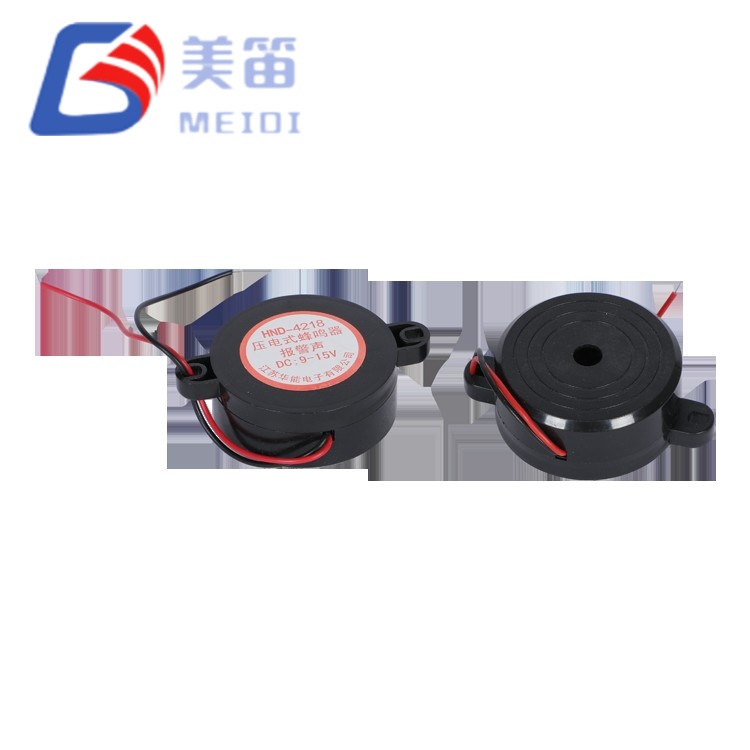
An active buzzer contains a built-in oscillator and sounds the moment DC power is applied — the easiest buzzer type to integrate. A buzzer manufacturer for active piezo should state operating voltage precisely (commonly 3 V, 5 V, or 12 V), SPL at distance, and resonant frequency, with stable tooling so every batch matches. MEIDI's active piezo line covers 12 V alarm units up to 100 dB minimum.
Passive (External-Drive) Piezo Buzzers
A passive buzzer has no internal oscillator and needs a square-wave or PWM signal from your microcontroller. A buzzer manufacturer for passive piezo must support your firmware's tone plans and quote peak-to-peak drive voltage, resonant frequency band, and SPL consistently. This buzzer type rewards a manufacturer that publishes 4000 Hz-class resonance where the ear is most sensitive.
Electromagnetic Buzzers
Electromagnetic buzzers use a coil and diaphragm like a miniature speaker, reaching lower frequencies and higher sound pressure than piezo at the cost of more current. A buzzer manufacturer offering both piezo and magnetic families can recommend the right trade-off: piezo for efficiency, magnetic for loud low-pitch alerts that cut through ambient noise.
SMD and Through-Hole Form Factors
Automated assembly demands a buzzer manufacturer comfortable with both SMD and through-hole packages. Surface-mount buzzers save PCB space and ride the pick-and-place line; through-hole units suit panels and traditional boards. A buzzer manufacturer that offers both keeps your assembly process simple as designs shrink toward 8.5 × 8.5 × 3.0 mm footprints.
Waterproof and Sealed Buzzers
Outdoor, washdown, and marine products need a buzzer manufacturer that seals the element against water and dust. A buzzer manufacturer for sealed units should publish the IP rating with test data, not just a logo, and verify it on production batches before shipment.
Comparison at a Glance
Manufacturer
Region
Primary Strength
Best For
MEIDI
China
Export focus, full buzzer families, customization
OEM/ODM buyers needing tailored specs and certs
Murata
Japan
Miniature multilayer piezo ceramic
Wearables, smartphones, space-constrained IoT
TDK
Japan
Unimorph piezo, automotive-grade
Automotive and industrial alerting
Sonitron
Belgium
High-SPL ruggedized piezo
Industrial, medical, marine harsh environments
Kingstate
Taiwan
High-volume, cost-controlled
Appliance and consumer OEMs
CUI Devices / Same Sky
USA
Catalog range, design-in support
Small/mid OEMs, fast prototyping
PUI Audio
USA
Lead-free, high-temp, high-SPL
Medical, industrial, security signaling
BeStar
China
Scale, automotive/medical depth
Volume automotive and embedded programs
Ariose
Taiwan
High-throughput SMD/magnetic
Appliance, security, consumer volume
Qlight
South Korea
Sounder + beacon signaling
Industrial machinery and safety status
Buzzer Type
Who Covers It Well
What to Verify
Active piezo
MEIDI, TDK, Murata
Voltage, SPL at distance, resonant frequency
Passive piezo
MEIDI, Murata, Kingstate, Ariose
Drive voltage p-p, resonance band, SPL
Electromagnetic
MEIDI, Kingstate, PUI Audio, Ariose
Current draw, frequency, SPL
SMD
MEIDI, Murata, CUI/Same Sky, Ariose
Footprint, reflow compatibility
Sealed / waterproof
MEIDI, Sonitron, PUI Audio
IP rating with test data
How to Choose Among These Manufacturers
A top-10 list narrows the field; your application closes the deal. Start from the signal itself: a passive piezo buzzer needs a drive signal from your firmware but rewards you with programmable tones, while an active buzzer is simplest when you only need a fixed alert. Match the resonant frequency to your drive circuit — driving off-resonance can drop output by 10 dB. Confirm sound pressure level at a defined distance (10 cm for a bare element, 1 m for a panel unit) and add 10–15 dB above your ambient noise.
Then weigh logistics. A Japanese or Belgian buzzer manufacturer may offer unmatched miniaturization or ruggedization but longer lead times and higher unit cost; a Taiwan or China-based buzzer manufacturer typically wins on volume economics and rapid customization. If your program is automotive or medical, prioritize a buzzer manufacturer with the relevant industry certifications and the batch records to prove consistency. Request the ISO certificate number and audited site, plus SPL and frequency data measured on your actual drive voltage, before you commit to a trial order. A buzzer manufacturer that answers these without hesitation is the one worth qualifying.
Red Flags When Evaluating a Buzzer Manufacturer
Copied catalog, no production line. A buzzer manufacturer that shows only a reseller's catalog — no real factory — is a supply risk.
SPL without distance. A buzzer manufacturer that quotes sound pressure without a measurement distance is quoting a number you cannot verify.
Certificate site mismatch. A buzzer manufacturer whose ISO certificate lists a different site than the quoted factory is likely renting paperwork.
No compliance docs. A buzzer manufacturer that cannot supply RoHS or REACH documents will stall your shipment at customs.
No batch records. A buzzer manufacturer with no traceability cannot support you at volume when a single unit drifts.
A professional buzzer manufacturer answers all of these without hesitation, because its process is built to be audited. Treat silence on any point as a reason to qualify a second supplier from this list before you place a production order.
Frequently Asked Questions
Q1: How were these buzzer manufacturers selected?
A: We weighted product breadth, export readiness, certifications (ISO 9001/14001, RoHS/REACH/CE), documented acoustic consistency, and track record, drawn from publicly reported market positioning. It is a curated buyer's shortlist, not an audited revenue ranking.
Q2: Should I choose a global or a local buzzer manufacturer?
A: Choose on total cost and risk, not geography alone. A global buzzer manufacturer with export experience shortens qualification and supports certifications; a regional one may cut lead time. The right answer depends on your volume, customization needs, and compliance requirements.
Q3: Which certifications matter most for export?
A: For general export, ISO 9001, ISO 14001, RoHS, REACH are the baseline a buzzer manufacturer should hold. Automotive or medical programs may require additional industry-specific certificates — verify the exact document your application demands.
Q4: Can these suppliers provide both active and passive buzzers?
A: Most on this list cover multiple technologies. MEIDI, Murata, TDK, Kingstate, CUI/Same Sky, and PUI Audio all span piezo and/or electromagnetic families; match the type to whether you want a fixed tone (active) or programmable tones (passive).
Q5: How does MEIDI compare with the larger names on the list?
A: The global leaders excel at miniaturization and automotive scale; MEIDI's edge is export-focused customization, full-family coverage, and direct engineering support for OEM/ODM specifications, with 15 years of export experience and a factory established in 2011.
Q6: How do I request samples from a buzzer manufacturer?
A: Send your target voltage, resonant frequency, required SPL at distance, size limit, and environment. A capable buzzer manufacturer returns a datasheet tied to the exact model, sample units, and batch test data. Start with one technical contact rather than a generic sales inbox.
Q7: What SPL should I specify, and at what distance?
A: Ask the buzzer manufacturer for SPL measured at a defined distance — 10 cm for a bare element, 1 m for a panel unit. Add at least 10–15 dB above your ambient noise, and apply the 6 dB-per-distance-doubling rule for your listener position.
Q8: Can a buzzer manufacturer customize voltage, frequency, and size?
A: Yes. MEIDI supports OEM/ODM customization of operating voltage, resonant frequency, package, and marking. A flexible buzzer manufacturer treats your specification as the starting point, not a limitation.
Watch Buzzers in Action
See MEIDI buzzers demonstrated — and follow us for new product videos
LinkedIn Follow Haya Liu on LinkedIn for engineering tips and buzzer demo videos.
Facebook Like our page MEIDI Buzzer on Facebook for weekly product videos and application clips.
Conclusion
The right buzzer manufacturer is the one that matches your signal, your environment, and your compliance needs — not the one with the lowest quote. The ten companies above represent a genuinely global cross-section of proven producers, each strong on a different axis: miniaturization, ruggedization, volume economics, or customization. Use the comparison tables and the checklist in the previous section to narrow them to the two or three worth a sample request.
If you are shortlisting suppliers for your next project, contact our team for datasheets, samples, and a free technical consultation. A professional buzzer manufacturer should make evaluation easy — and we are ready to prove it.
We use cookies to offer you a better browsing experience, analyze site traffic and personalize content. By using this site, you agree to our use of cookies. Privacy Policy