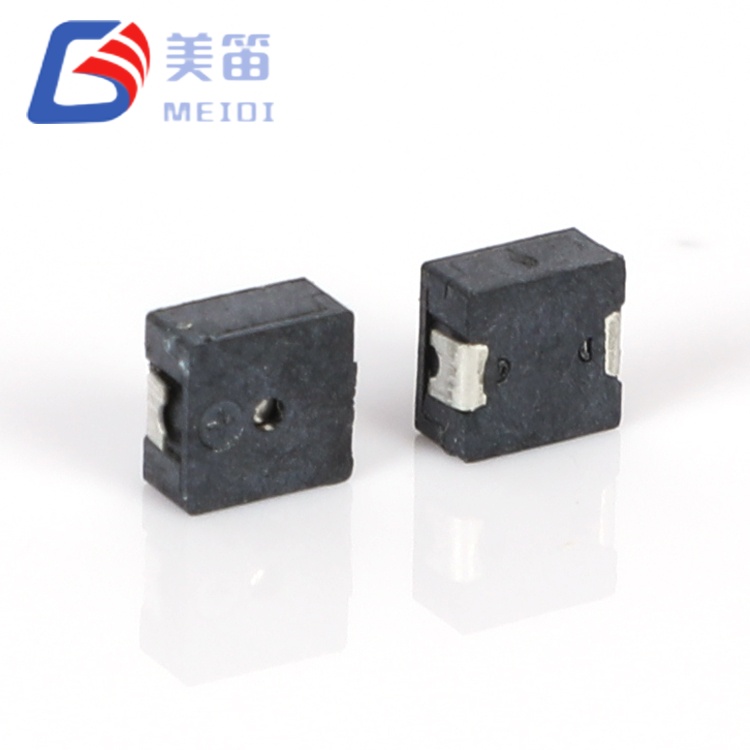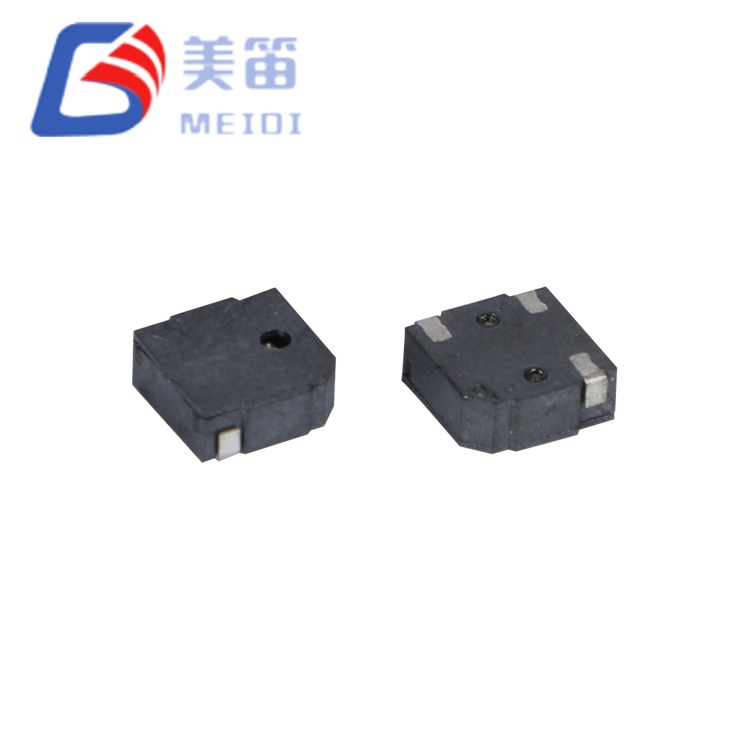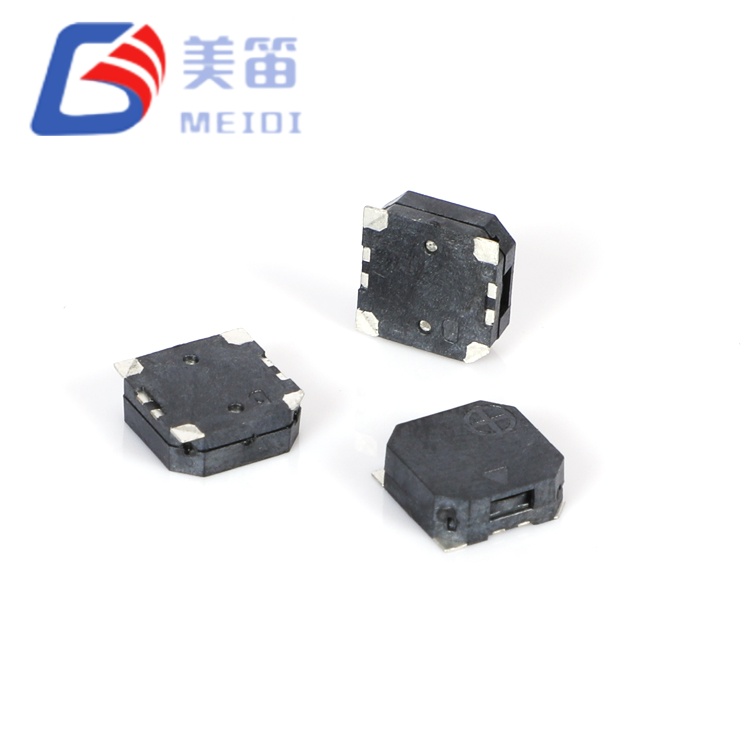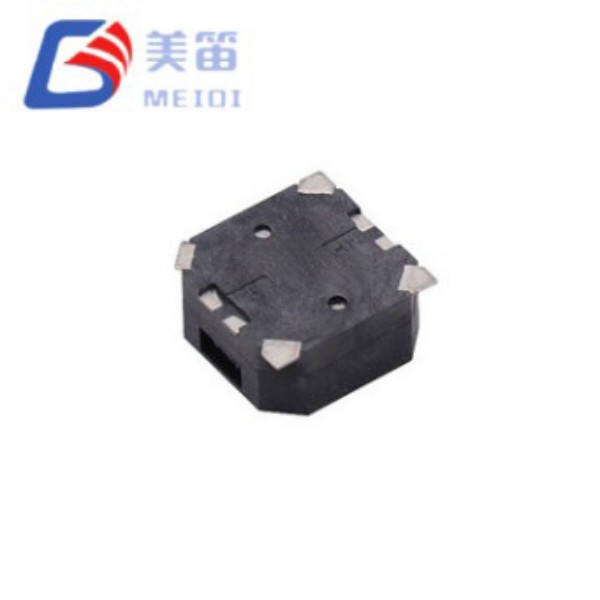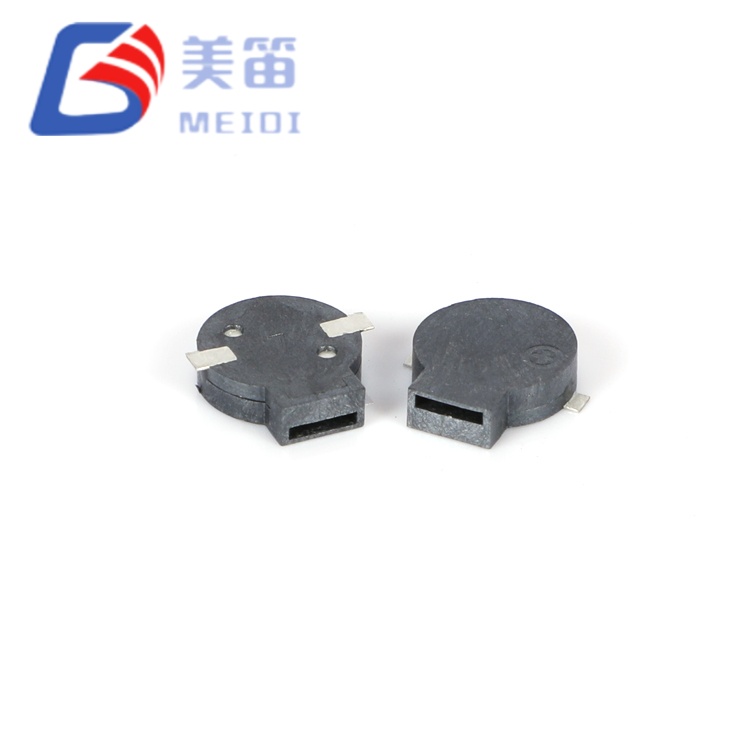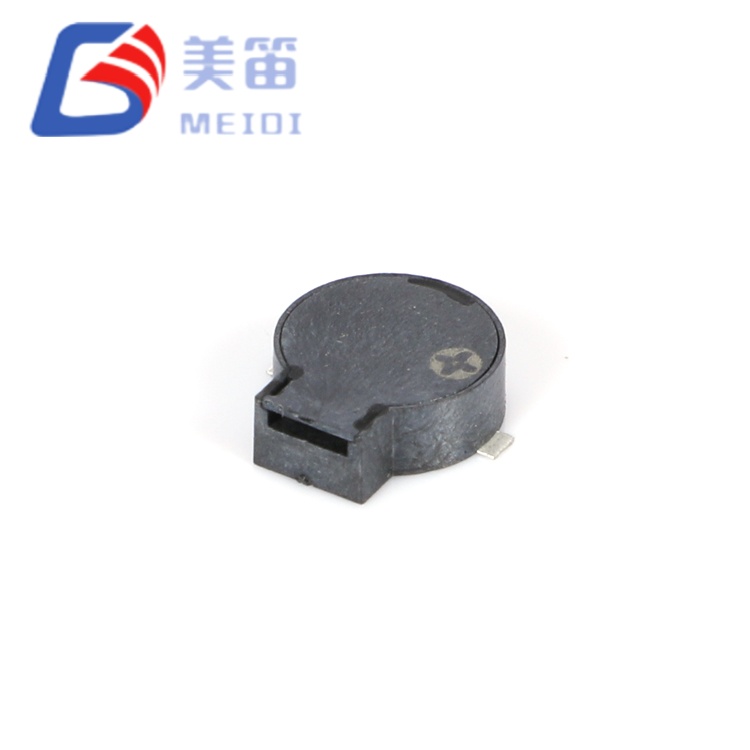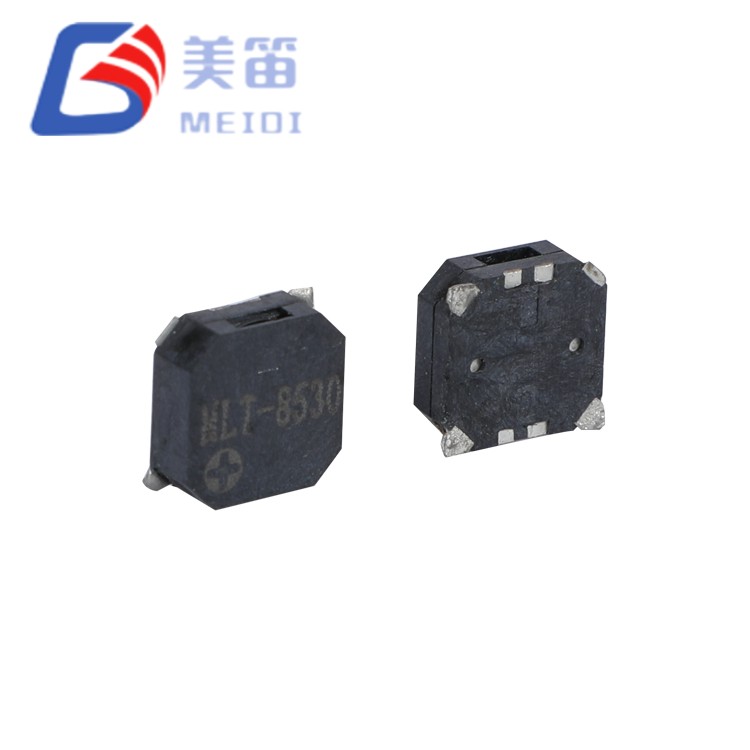
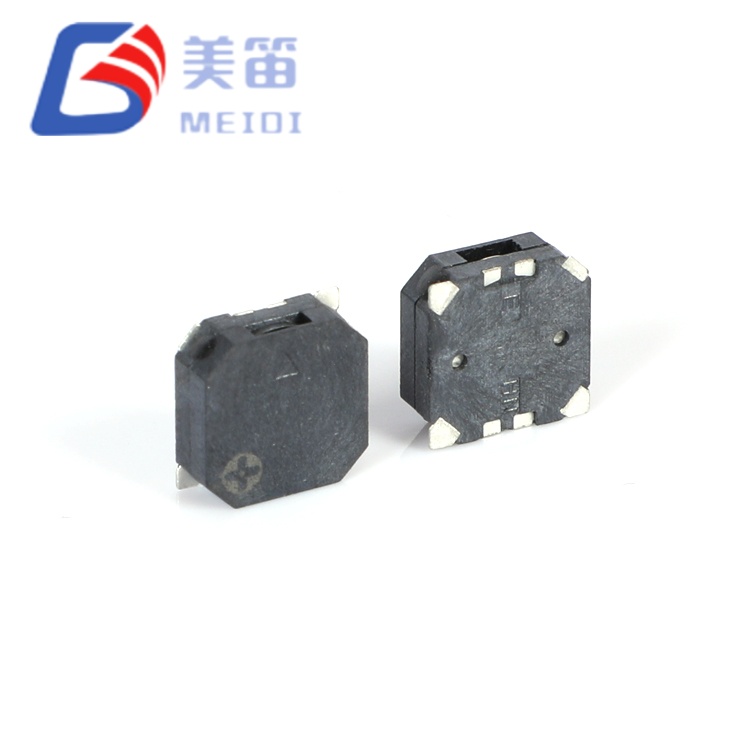
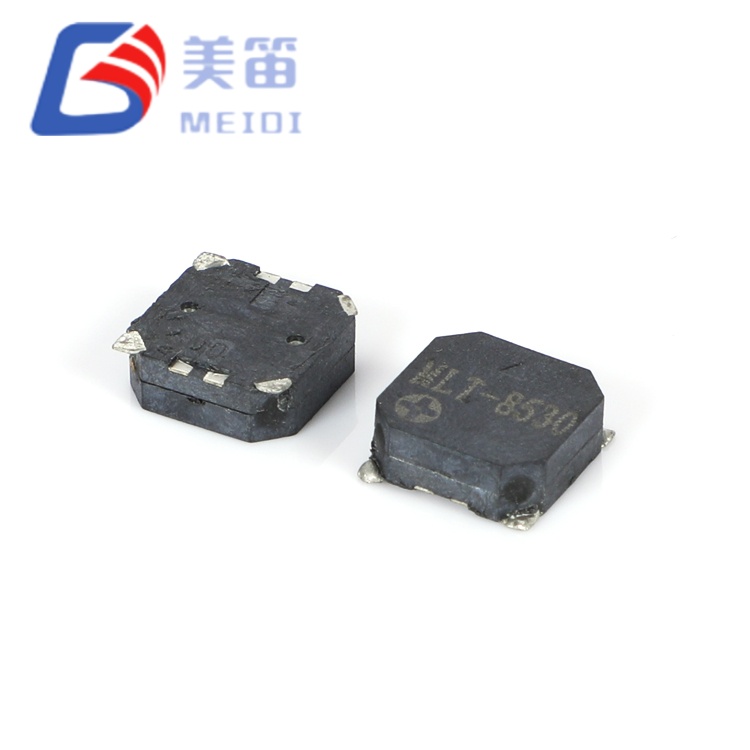
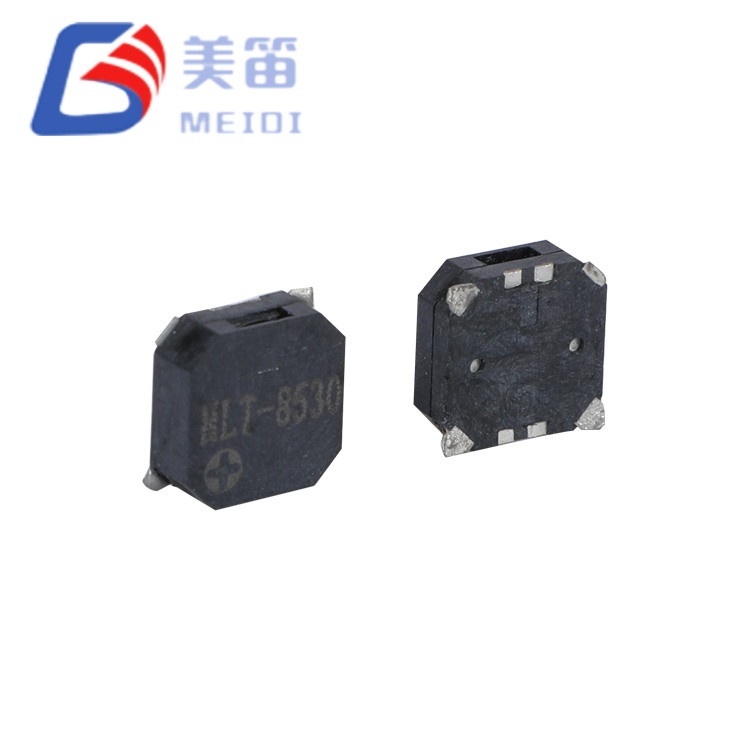
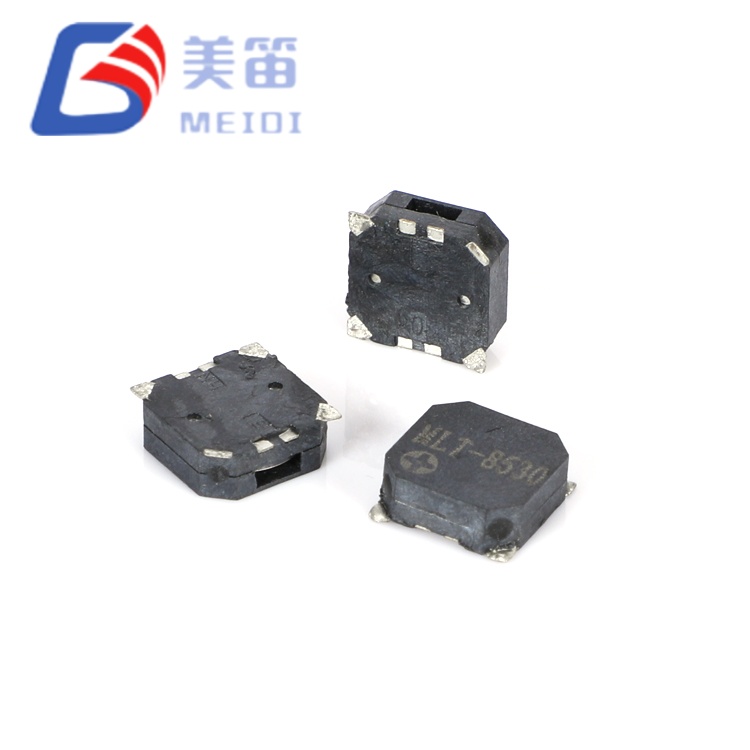
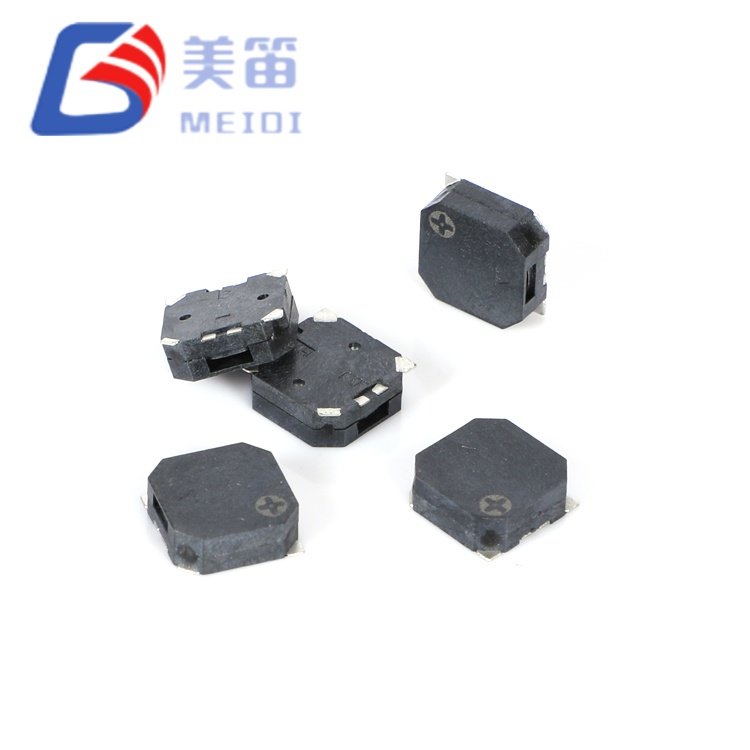
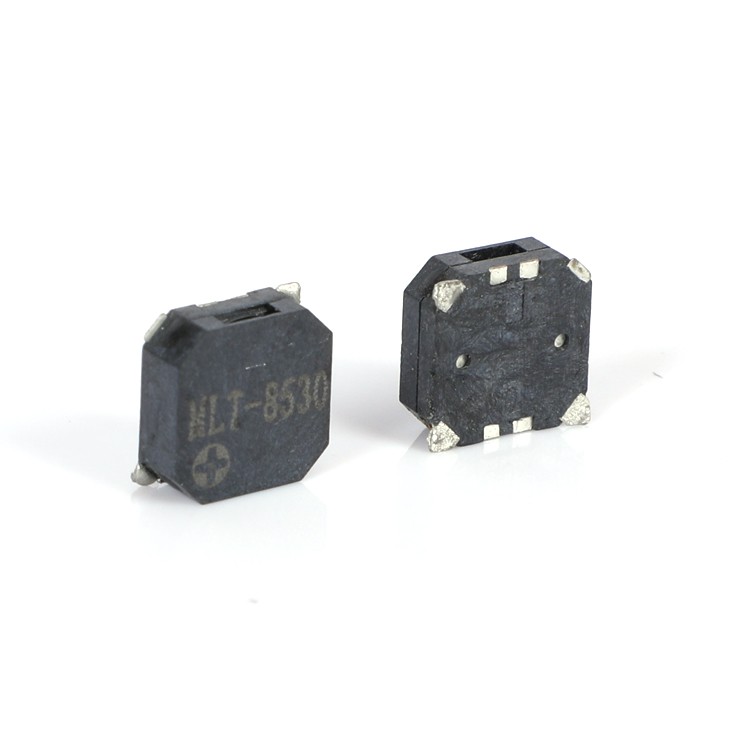
The MLT‑8530‑16R is an 8.5*8.5*3mm Surface Mount Magnetic Passive Buzzer engineered for applications where acoustic output cannot be compromised by surface‑mount assembly constraints. With measured sound pressure levels of 92.5–95.3 dB at 10 cm, this component approaches the performance of much larger through‑hole magnetic buzzers while maintaining full SMT compatibility – making it suitable for industrial alarm systems, public safety infrastructure, and heavy machinery warning installations.
Manufactured at MEIDI’s Jiangsu facility, the MLT‑8530‑16R features a 16 ± 3 Ω coil impedance and 2700 ± 200 Hz resonant frequency with tightened frequency tolerance for consistent tonal character across production batches. The 3.6 V rated voltage (2.5–4.5 V range) supports Li‑ion battery systems and 5 V logic rails, while the black LCP housing withstands reflow soldering at 255 °C and operates from -30 °C to +70 °C. Each unit undergoes 100% electrical and acoustic verification, with sample batch data confirming SPL values consistently exceeding 92 dB – providing substantial margin above the 85 dB minimum specification.
The 8.5*8.5*3mm Surface Mount Magnetic Passive Buzzer represents the largest SMD electromagnetic buzzer in MEIDI’s MLT series, employing an 8.5 mm square diaphragm to maximise acoustic radiation efficiency. Compared to the 7.5 mm MLT‑7525‑16R, this 8.5 mm variant increases diaphragm area by approximately 28%, translating to the higher sound pressure levels verified through production testing – a meaningful advantage for applications where audibility margins are critical.
The passive transducer architecture requires an external AC drive signal – typically a 2700 Hz square wave from a microcontroller PWM output or dedicated oscillator. This design choice provides firmware engineers with complete control over alert patterns, frequency modulation, and duty‑cycle‑based volume scaling. The 16 Ω coil impedance is optimised for 3.6 V nominal operation, balancing current draw (≤100 mA) with sufficient magnetic flux for strong diaphragm excitation.
The tightened 2700 ± 200 Hz frequency tolerance – a 33% reduction in variance compared to standard ±300 Hz specifications – ensures consistent tonal character across production batches. This is particularly important in multi‑unit installations where frequency beating or perceptual mismatch between devices would be unacceptable, such as synchronised alarm networks or emergency evacuation systems with multiple sounders.
The 3.0 mm cavity height provides increased internal volume for resonance optimisation at 2.7 kHz. The extended operating temperature range (-30 °C to +70 °C) and storage range (-40 °C to +85 °C) support deployment in thermally demanding environments, from refrigerated logistics facilities to sun‑exposed outdoor equipment enclosures.
Largest SMD diaphragm in MLT series – 8.5 mm square housing accommodates maximum vibrating membrane area, delivering the highest achievable SMD sound pressure
Tightened ±200 Hz frequency tolerance – 33% reduction in batch‑to‑batch variation ensures consistent tonal character for multi‑unit installations
Measured 92.5–95.3 dB output – empirical performance exceeds 85 dB specification by 7.5–10.3 dB, providing substantial acoustic headroom
3.0 mm extended cavity height – increased internal volume enhances 2.7 kHz resonance efficiency without expanding footprint
16 ± 3 Ω impedance – optimised for 3.6 V Li‑ion systems and 5 V logic rails with moderate current demand
Extended thermal envelope – -30 °C to +70 °C operating range outperforms consumer‑grade limits for industrial reliability
| Parameter | Value |
| Product Type | Electromagnetic SMD Passive Buzzer |
| Rated Voltage | 3.6 V (o‑p) |
| Operating Voltage | 2.5 – 4.5 V (o‑p) |
| Sound Output at 10 cm | ≥ 85 dB |
| Operating Current | ≤ 100 mA |
| Resonant Frequency | 2700 ± 200 Hz |
| Coil Resistance | 16 ± 3 Ω |
| Operating Temperature | -30 °C ~ +70 °C |
| Storage Temperature | -40 °C ~ +85 °C |
| Dimensions (L × W × H) | 8.5 × 8.5 × 3.0 mm |
| Weight | 0.5 g |
| Housing Material | Black LCP |
| Soldering Method (Recommended) | Reflow: 255 ± 5 °C, 3 s; Preheat 180 °C, 40–70 s |
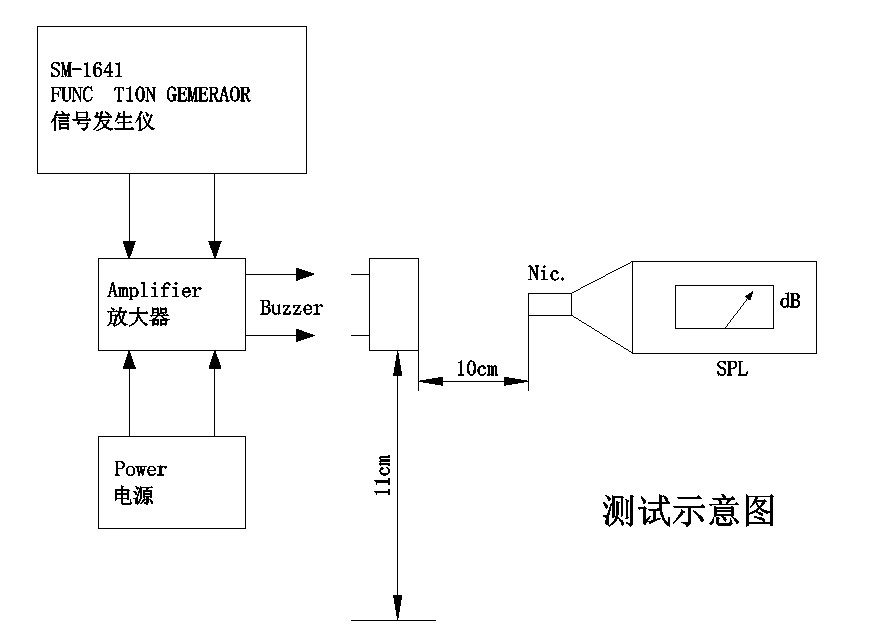
Production batch verification (n=10) under standardised test conditions – 3.6 V square wave, 2700 Hz, 50% duty cycle, 10 cm free‑field measurement – confirms the following performance distribution:
| Parameter | Minimum | Maximum | Mean |
| Sound Pressure Level | 92.5 dB | 95.3 dB | 93.8 dB |
| Operating Current | 70.9 mA | 73.0 mA | 71.9 mA |
| Resonant Frequency | 2700 Hz | 2700 Hz | 2700 Hz |
| Coil Resistance | 15.7 Ω | 16.4 Ω | 16.1 Ω |
The acoustic output margin above the 85 dB minimum specification – 7.5 dB to 10.3 dB – represents a 2.4× to 3.4× increase in acoustic power. This headroom accommodates voltage sag, enclosure attenuation, dust accumulation on grilles, and component aging throughout the product lifecycle. All ten samples tested at precisely 2700 Hz, indicating production process control well within the ±200 Hz tolerance and approaching centre‑frequency accuracy.
Commercial indoor alarm systems – audible notification in office buildings, retail spaces, and controlled indoor environments where minimum SPL thresholds are required; not suitable for fire safety applications requiring UL/EN 54 certification without additional system‑level validation
Heavy industrial machinery – collision avoidance, crane movement, and press operation warnings in environments exceeding 85 dB ambient noise where standard buzzers are inaudible
Public safety and security infrastructure – perimeter intrusion, riot control, and mass notification systems requiring immediate auditory attention
Marine control panel indicators – audible alerts in enclosed bridge consoles, navigation equipment, and interior control panels with IP‑rated environmental protection; not for direct weather exposure
Confined‑space industrial equipment – vehicle proximity warnings and process alerts in enclosed warehouse and factory environments
Indoor agricultural processing equipment – operation alerts in grain handling, sorting, and packaging machinery within enclosed facilities
The MLT‑8530‑16R addresses a specific market requirement: achieving through‑hole‑comparable acoustic output while maintaining surface‑mount assembly efficiency. At 8.5 × 8.5 mm, this component is among the largest SMD electromagnetic buzzers commercially available, yet it remains substantially smaller than 12 mm or 16 mm through‑hole alternatives of similar SPL capability. For manufacturers committed to SMT processes – whether for cost reduction, automation efficiency, or board‑space optimisation on complex multi‑layer PCBs – this component eliminates the need to compromise on audibility.
The tightened frequency tolerance addresses a subtle but significant consideration in professional alarm systems. When multiple buzzers operate simultaneously, frequency differences create audible beating patterns that can be perceived as distressing or ambiguous. The MLT‑8530‑16R’s reduced variance minimises this effect, producing a more coherent, authoritative tonal character – an important attribute for emergency notification systems where clear, unambiguous alert perception is critical.
The 0.5 g mass – identical to the smaller MLT‑7525‑16R despite the larger footprint – indicates efficient material utilisation and suggests comparable vibration resistance and mechanical durability. The extended temperature ratings support deployment in thermally challenging environments where consumer‑grade components would fail prematurely.
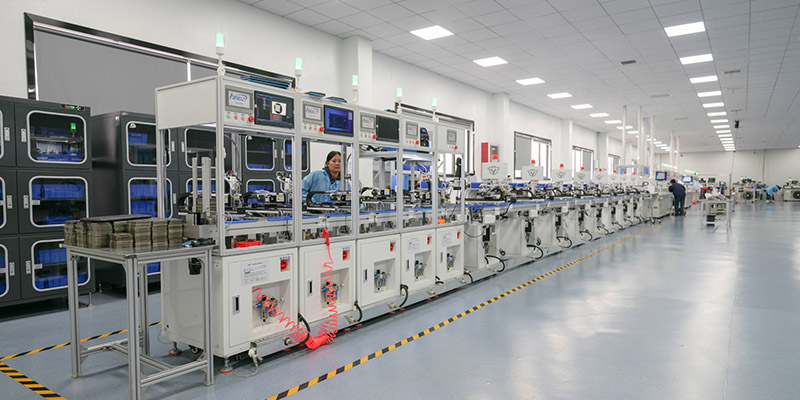
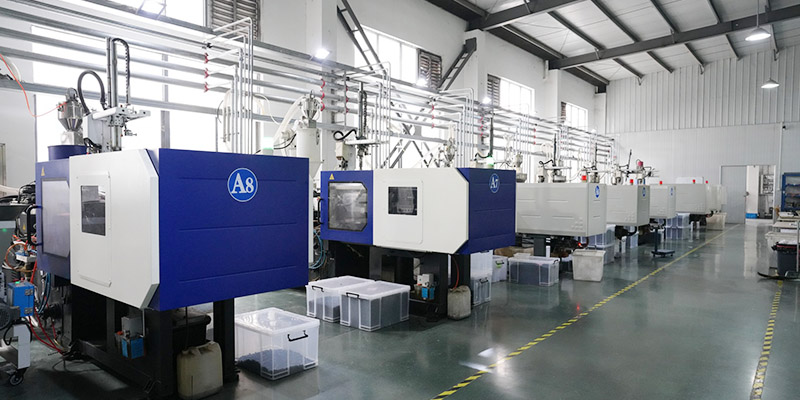
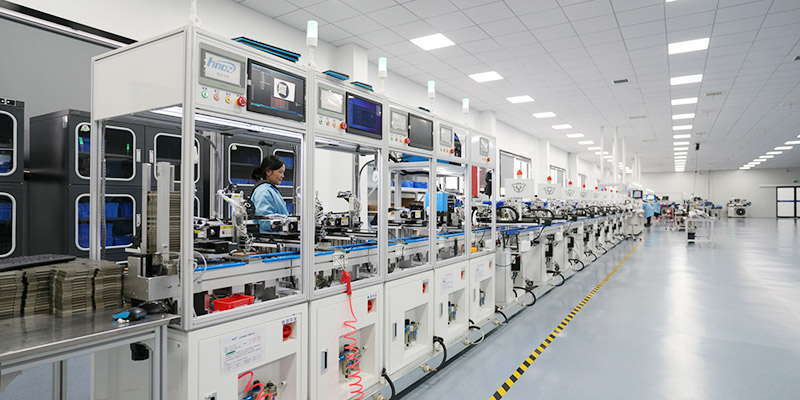
MEIDI manufactures the MLT‑8530‑16R on dedicated SMD assembly lines featuring automated coil winding, soldering, and acoustic tuning. Our Jiangsu facility operates under ISO 9001:2015 quality management, with statistical process control applied at every production stage.

Each production batch undergoes comprehensive qualification:
Acoustic verification – 100% SPL measurement at rated voltage; sample batch confirms 92.5–95.3 dB, exceeding the 85 dB minimum
Frequency stability – statistical sampling at 2700 ± 200 Hz; production samples consistently measure 2700 Hz, indicating centre‑frequency accuracy
Coil resistance screening – 16 ± 3 Ω verification; measured values typically 15.7–16.4 Ω
High‑temperature storage – 48 hours at +80 ± 2 ℃; full parameter recovery after 2‑hour ambient stabilisation
Low‑temperature storage – 48 hours at -30 ± 2 ℃; verified activation at 2.5 V minimum
Thermal shock cycling – 5 transitions between -30 ℃ and +80 ℃ with 30‑minute dwell at each extreme
Mechanical stress validation – sinusoidal vibration (10–55 Hz, 1.0 mm amplitude, XYZ axes, 0.5 hours cumulative) and 75 cm free‑fall drop onto 10 mm hardwood (3 impacts)
Humidity resistance – 48 hours at 50 ± 5 ℃ / 90–95% RH with 2‑hour recovery and electrical characterisation
Solder heat resistance – 250 ± 5 ℃ for 10 ± 0.5 seconds with 2.0 mm body‑to‑solder clearance
RoHS and REACH compliance documentation is available upon request. Lot identification codes enable full traceability to production date, test records, and raw material batches.
Q1: How does the MLT‑8530‑16R compare with the 7.5 mm MLT‑7525‑16R in the same series?
Both components share identical electrical parameters (16 Ω, 2.5–4.5 V, 2700 Hz) and the same 3.0 mm height. The MLT‑8530‑16R occupies a larger 8.5 mm square footprint versus 7.5 mm for the MLT‑7525‑16R, with correspondingly higher acoustic output – measured 92.5–95.3 dB versus 86–88 dB. The selection decision is a direct trade‑off between PCB area availability and required SPL. For applications where the larger footprint is acceptable, the MLT‑8530‑16R provides significantly greater acoustic headroom. Both components share LCP reflow compatibility and the same extended temperature rating.
Q2: What is the recommended drive circuit for the MLT‑8530‑16R?
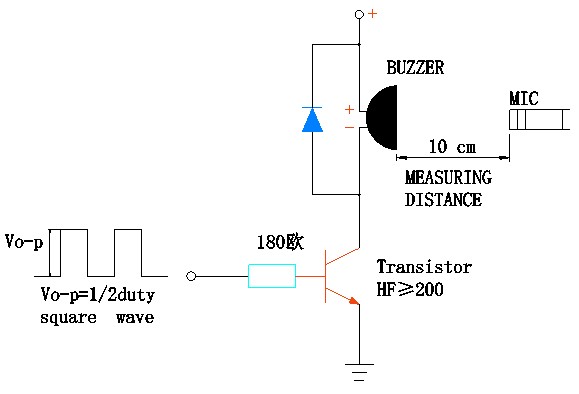
A 2700 Hz square wave with 50% duty cycle and 3.6 V amplitude produces maximum acoustic output. The 16 Ω impedance allows direct drive from many MCU GPIO pins, provided they can source ≥100 mA peak current. For applications where GPIO current is limited, a small NPN transistor (e.g., 2N3904 or BC547) with a 1 kΩ base resistor and a flyback diode (1N4148) across the coil provides a robust, low‑cost driver. The flyback diode protects the transistor from inductive voltage spikes generated during switching.
Q3: Can the MLT‑8530‑16R be used in outdoor or moisture‑prone environments?
The component itself is rated for 90–95% RH non‑condensing operation per the humidity resistance test (48 h at 50 °C / 95% RH). However, it is not hermetically sealed and should not be exposed to direct moisture or immersion. For outdoor applications, the buzzer should be mounted inside an IP‑rated enclosure with appropriate acoustic porting (e.g., a membrane or labyrinth) that allows sound transmission while preventing water ingress. MEIDI offers conformal coating as a custom option for volume orders – contact our engineering team to discuss ingress protection requirements.
Q4: What is the significance of the ±200 Hz frequency tolerance compared to ±300 Hz?
The tightened tolerance represents a 33% reduction in frequency variance across production batches. In single‑unit applications, the difference is perceptually subtle. In multi‑unit installations – such as alarm panels with multiple sounders, security systems with distributed annunciators, or phased‑array acoustic designs – reduced frequency variation minimises audible beating patterns that occur when similar tones interact. The result is a more coherent, professional acoustic character that projects consistency and reliability.
Q5: Are custom frequency or impedance variants available for OEM orders?
Yes. MEIDI supports OEM customisation for volume orders, including alternative resonant frequencies (within 2.0–4.0 kHz), custom coil impedance values, and specialised housing materials or colours. Minimum order quantities and lead times vary by customisation scope. Contact our OEM support team with your specifications for a feasibility assessment and quotation.
Q6: What is the expected operating lifetime under continuous excitation?
The standard qualification includes 96 hours of continuous operation at 25 °C with a 50% duty‑cycle square wave at rated voltage. For indefinite continuous‑tone applications, MEIDI recommends limiting duty cycle to 50% or implementing intermittent alert patterns (e.g., 1 second on, 3 seconds off) to reduce coil heating and extend service life. Extended lifetime test data for specific operating conditions is available upon request – contact our applications engineering team with your target duty cycle and ambient temperature profile.
For complete technical documentation, PCB footprint recommendations, reference driver circuits, or volume pricing, contact MEIDI Engineering Support. Engineering samples are available for qualified development projects.
Our applications engineering team typically responds within one business day with reflow profile guidance, acoustic enclosure integration notes, and design‑in support tailored to your specific product requirements.
Address
No.6, Wenlin Road, Chenbao Town, Xinghua City, Jiangsu Province, China
Tel