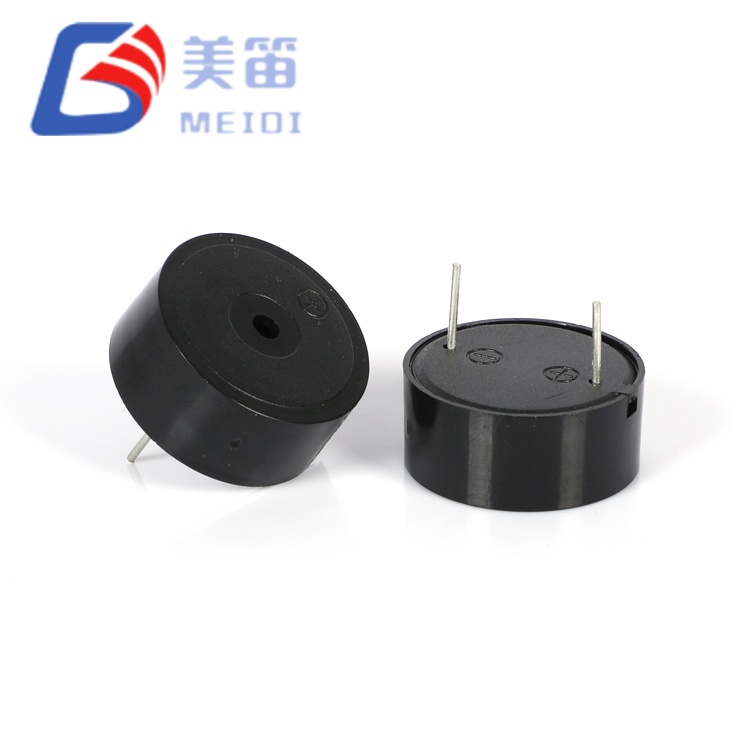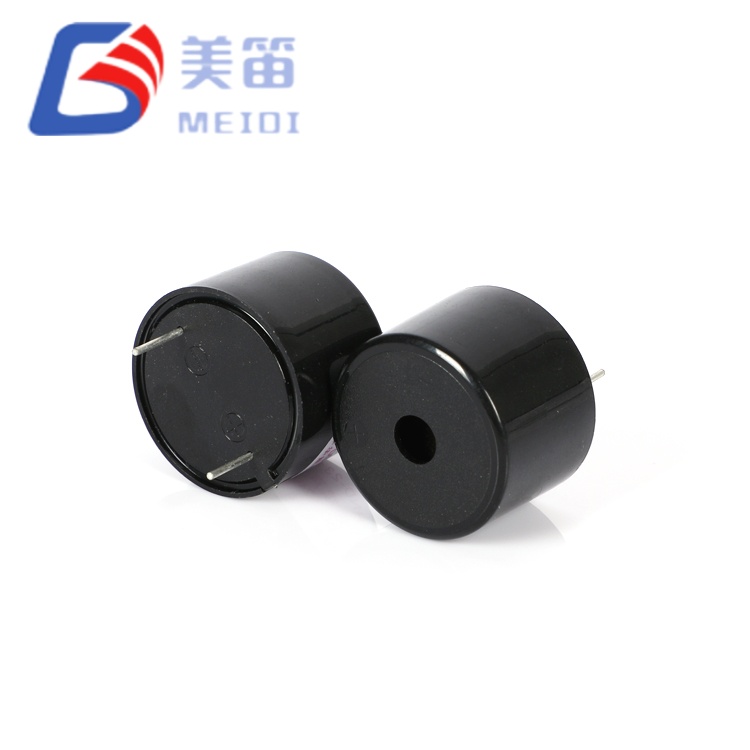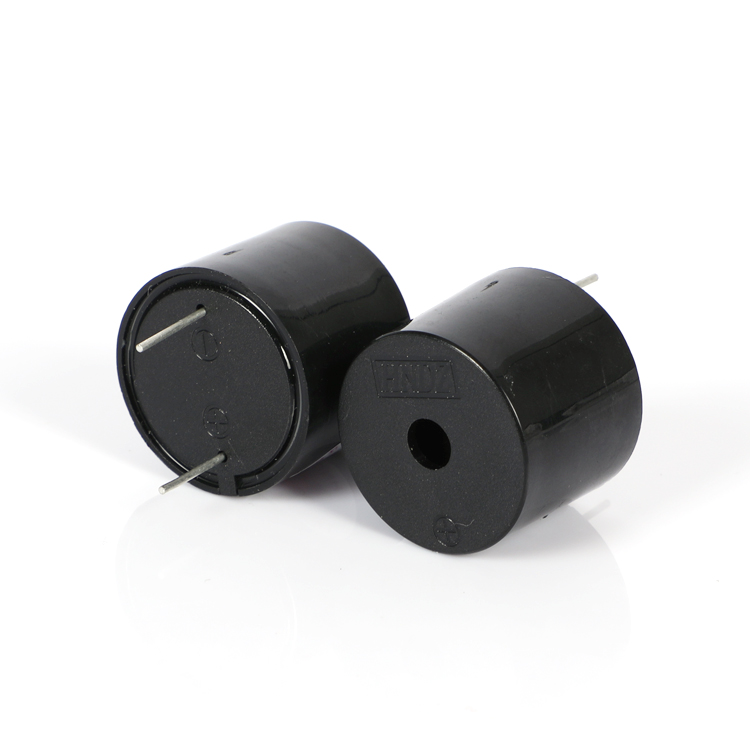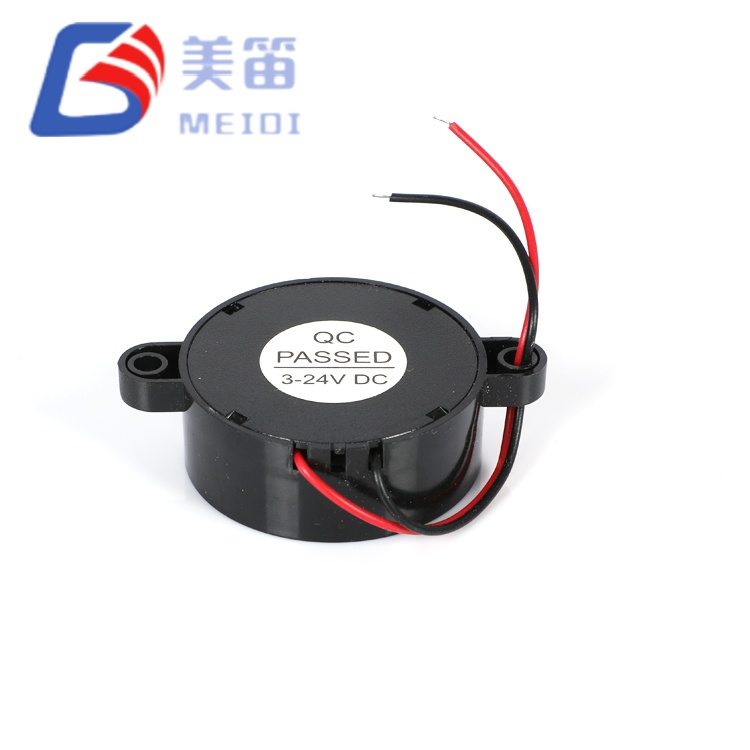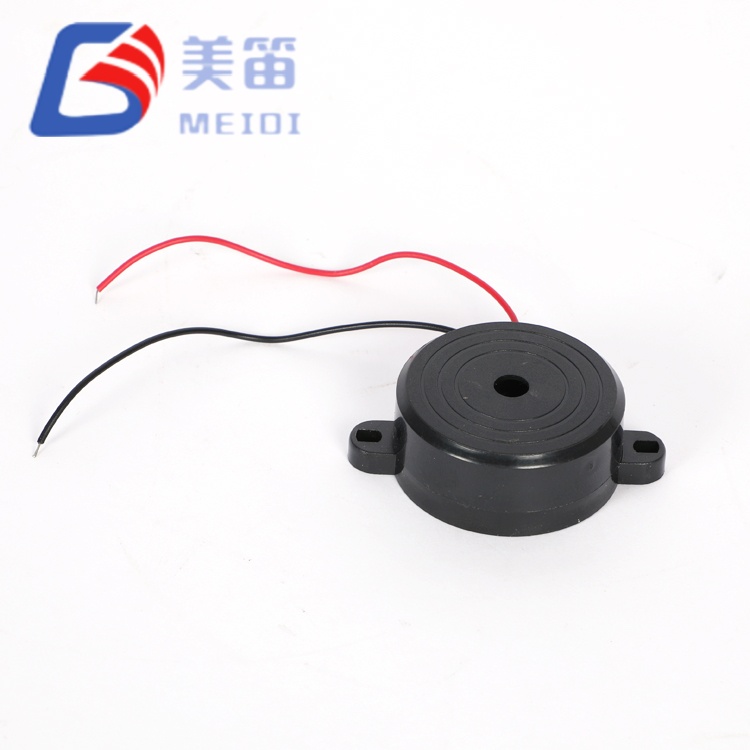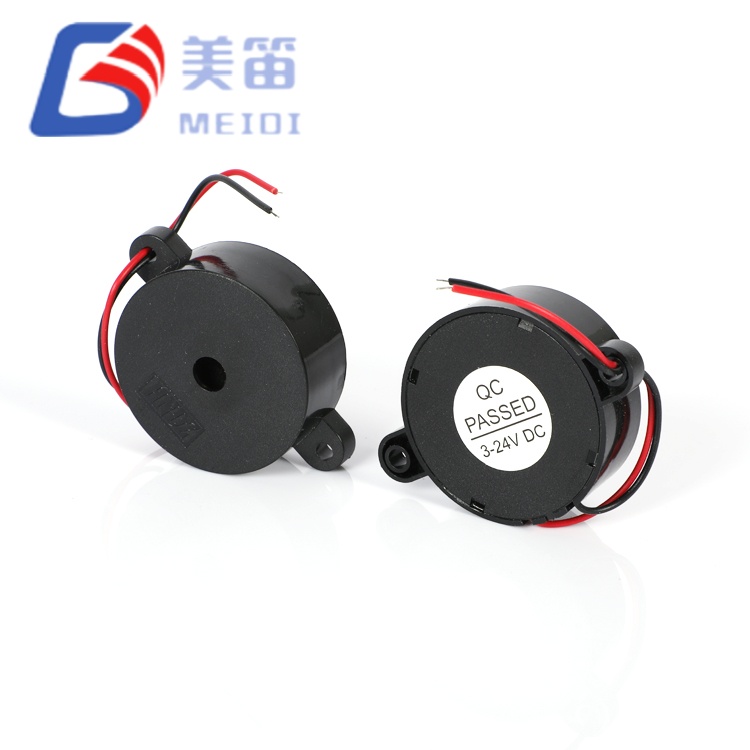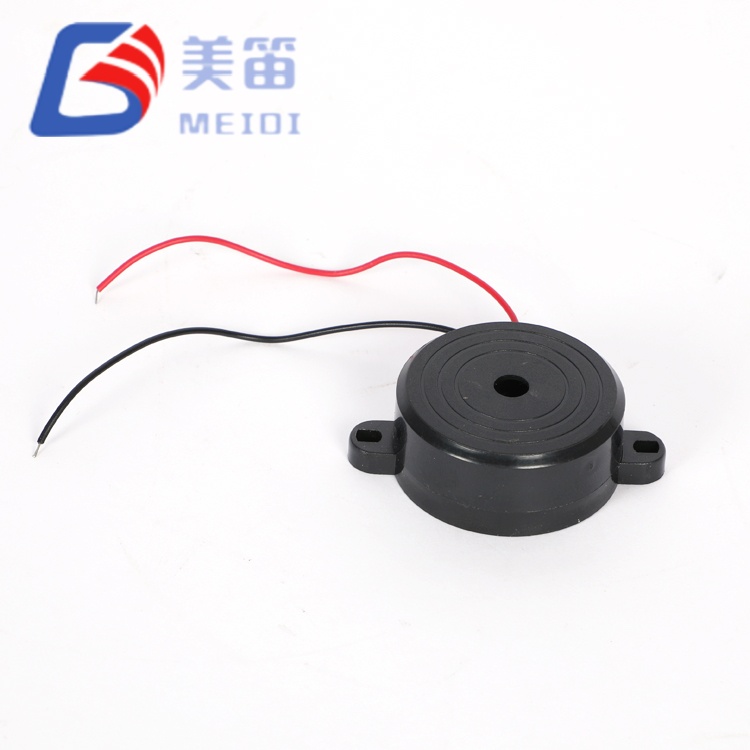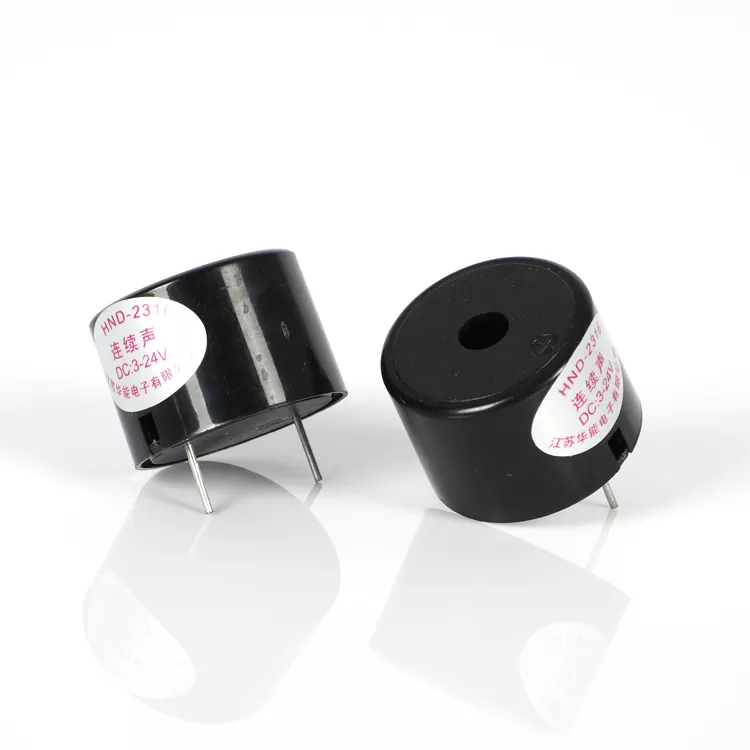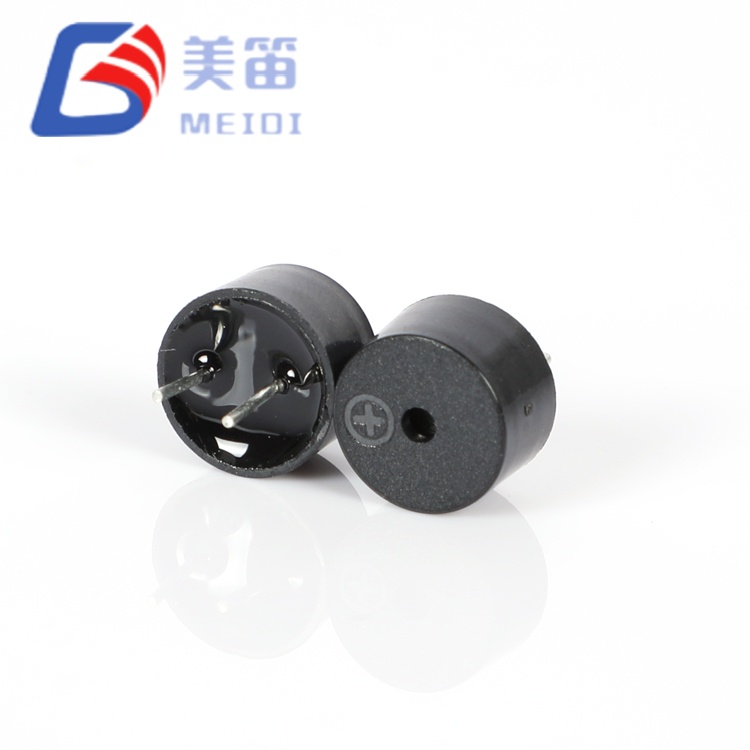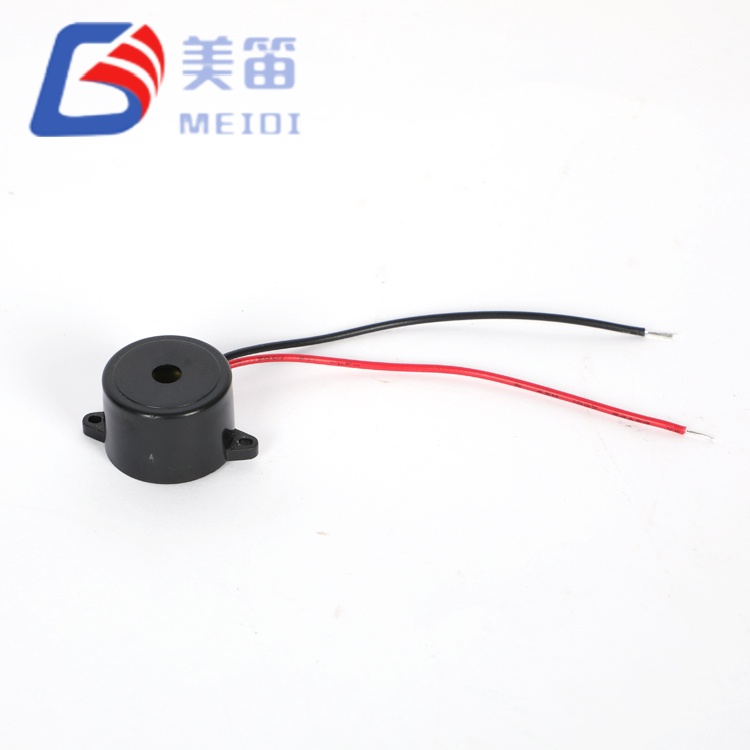
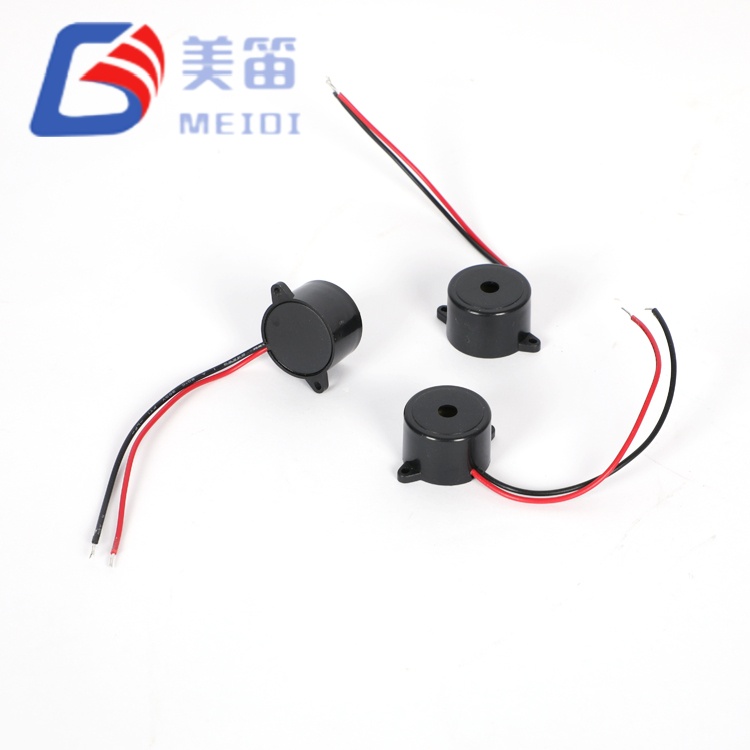
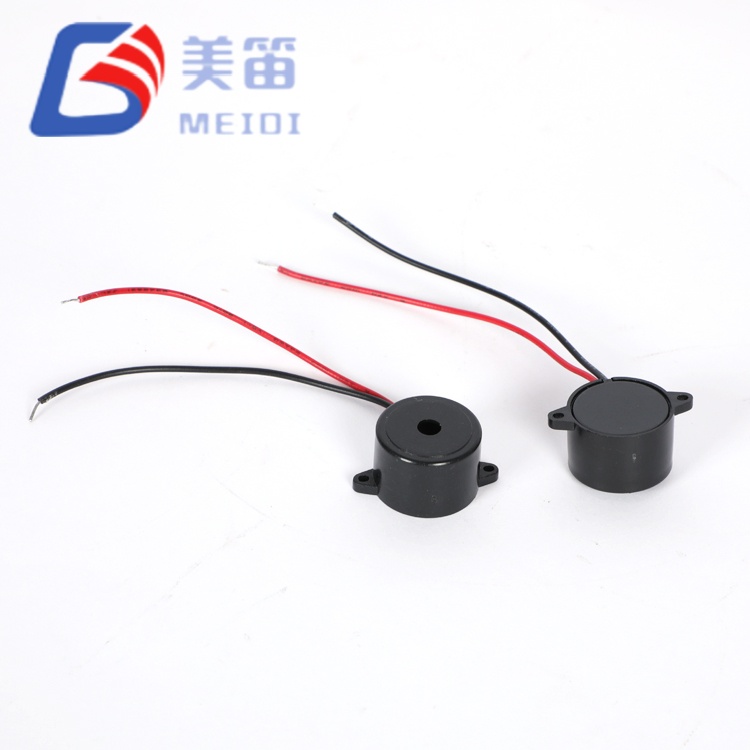
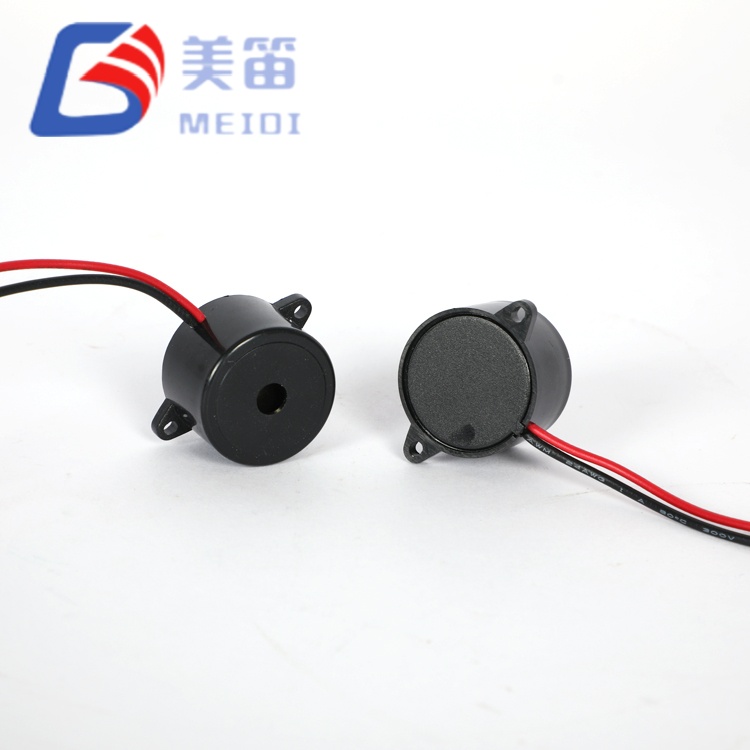
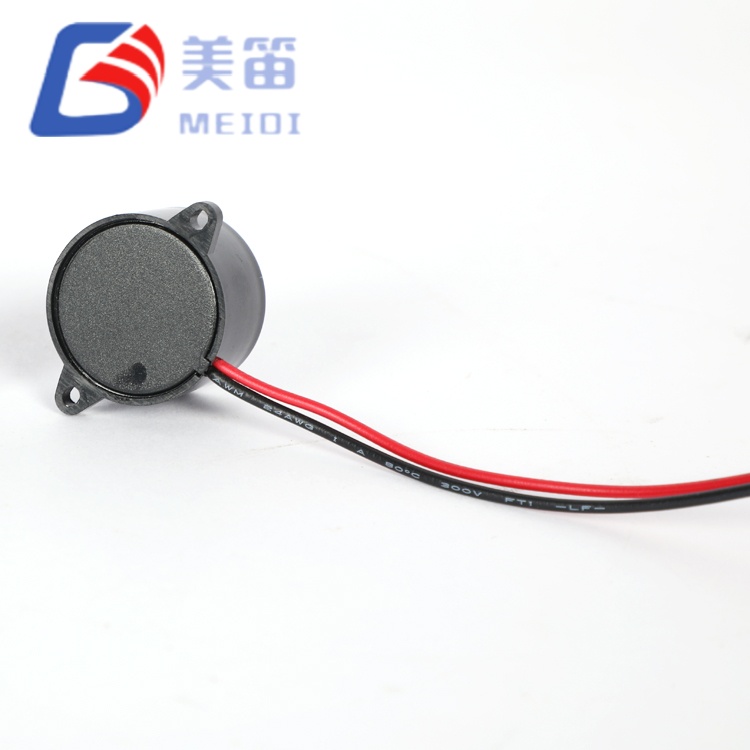
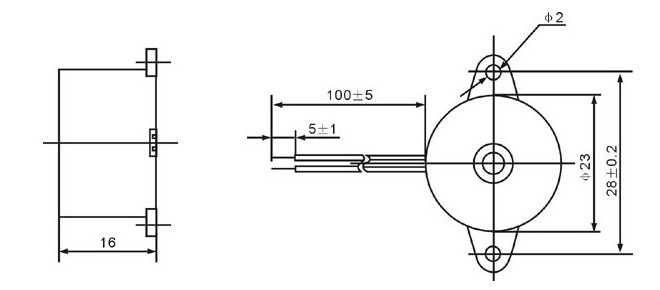
The HND‑2316L is the lead‑wire configuration of MEIDI's 23 mm active buzzer platform. It integrates the same acoustic engine and drive circuit as the through‑hole 2316 Active Piezoelectric Buzzer with Wire Leads but replaces PCB pins with flying leads, allowing the sound source to be decoupled from the circuit board. The built‑in oscillator responds to any DC supply between 3 V and 24 V and delivers a 3000 Hz tone. At the rated 12 VDC, sound pressure level reaches at least 90 dB measured at 10 cm. The ABS housing retains the Φ23 × 16 mm footprint, and the entire assembly weighs 5 g. This part is commonly specified when the buzzer must be located behind a front grille, inside a hinged door, or at a height that differs from the main electronics enclosure.
Lead‑wire termination for remote placement away from the PCB
Electrical and acoustic performance identical to HND‑2316: ≥90 dB, 3000 Hz
Built‑in drive circuit — 12 VDC rated, 3–24 VDC operating range
Black ABS housing, Φ23 × 16 mm, 5 g
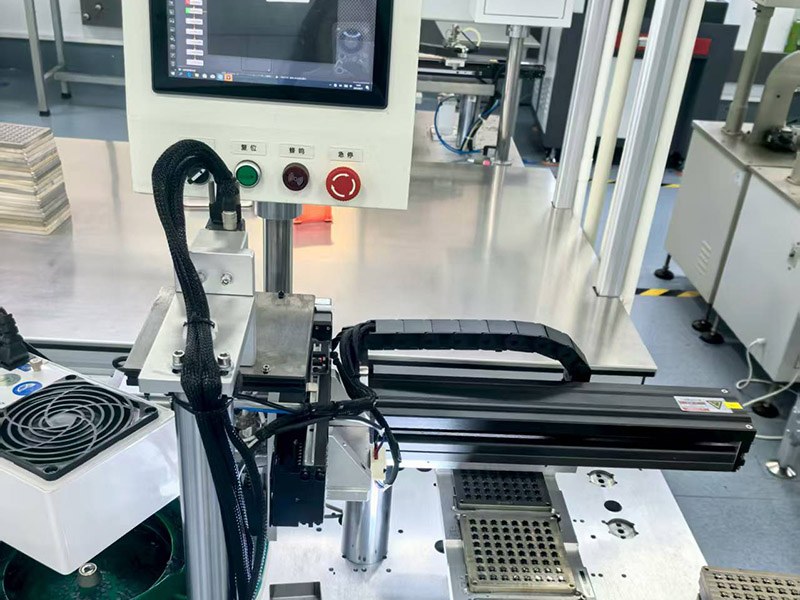
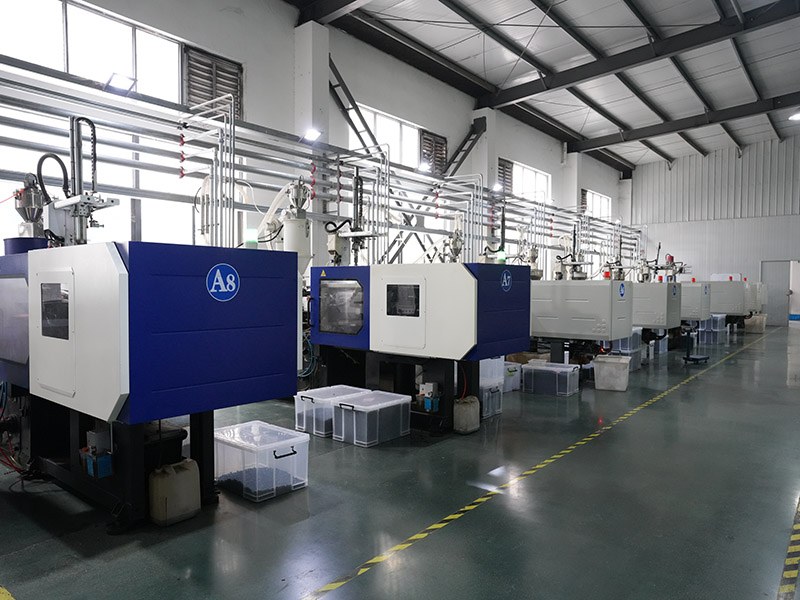
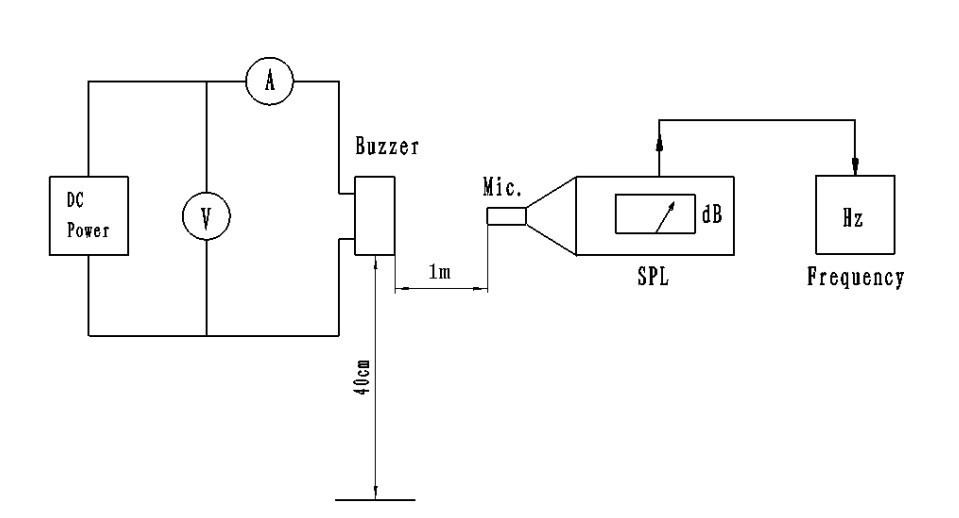
MEIDI produces the 2316 Active Piezoelectric Buzzer with Wire Leads in its Jiangsu facility, where the assembly sequence includes piezo ceramic bonding, PCB insertion, housing closure, and a dedicated lead‑wire soldering step. Pre‑stripped wires are hand‑soldered or resistance‑soldered to the buzzer terminals under monitored temperature and dwell time. A pull‑test is applied to a sample from each lot to verify mechanical integrity. Following wire attachment, every unit is acoustically screened: SPL, frequency, and current are measured at 12 Vp‑p, 3000 Hz using an automated test station. Pass‑through rate and SPL distribution are recorded for batch traceability.
The same seven‑item reliability suite used for the HND‑2316 (humidity, high‑temp storage, low‑temp storage, thermal cycling, drop, vibration, solder‑heat resistance) is applied to HND‑2316L samples. Test results are available for customers requiring qualification data as part of their component approval process.


| Parameter | Value | Test Conditions / Notes |
| Product Type | Piezoelectric Active Buzzer with Lead Wires | — |
| Rated Voltage | 12 VDC | — |
| Operating Voltage | 3–24 VDC | — |
| Resonant Frequency | 3000 ± 500 Hz | — |
| Sound Output at 10 cm | ≥90 dB | 3000 Hz square wave, 12 Vp‑p |
| Current Consumption | ≤10 mA | 3000 Hz square wave, 12 Vp‑p; parameter table ≤10 mA; test report header may reference ≤15 mA — see Test Report Summary |
| Operating Temperature | -20 ℃ ~ +80 ℃ | Continuous |
| Storage Temperature | -30 ℃ ~ +85 ℃ | Non‑operating |
| Dimensions (Dia × H) | Φ23 ± 0.5 × 16 ± 0.3 mm | Body only; drawing tolerance ±0.5 mm unless specified |
| Weight | 5 g | — |
| Housing Material | Black ABS | — |
| Capacitance | 12 ± 40% nF | Reference value per specification header; not verified per sample |
| Connection Type | Lead Wires | Manual solder to leads |
Because the 2316 Active Piezoelectric Buzzer with Wire Leadsis not constrained by a PCB footprint, designers have freedom to position the buzzer for maximum audibility or to fit irregular enclosure geometries. A few practices help preserve long‑term reliability:
Wire anchor points: Within the host enclosure, route the leads to a fixed terminal block or use a cable tie mounted to a standoff within 20–30 mm of the buzzer body. This isolates the soldered joints from vibration and accidental tugging.
Lead length considerations: Standard wire lengths are offered; longer custom options can be supplied. When specifying extended leads, consider the added series resistance and its negligible effect on the high‑impedance piezo input, but also the potential for radiated EMI from the buzzer's internal oscillator. A twisted‑pair arrangement or a small ferrite bead can mitigate this in sensitive circuits.
Enclosure acoustics: If the buzzer is placed behind a perforated panel or grille, ensure that the open area is at least equivalent to the sound port diameter. A severely restricted opening can attenuate SPL by several decibels.
Manual soldering to leads: Iron temperature of 350 ± 10 ℃ for 2–5 s is recommended, with heat applied primarily to the wire. Avoid lifting or bending the wire at the housing exit during handling.
Equipment panels where the buzzer is mounted on the front fascia and wired back to a control board located deeper in the chassis.
Security detectors that require an audible alert at a specific elevation, separated from the sensor electronics.
Industrial machines with distributed alarm points, all connected via wire harness to a single logic controller.
Automotive aftermarket add‑ons (parking sensor kits, blind‑spot indicators) where the buzzer is spliced into an existing 12 V circuit.
Retrofit projects replacing a failed PCB‑mount buzzer with a wire‑lead equivalent when board rework is impractical.
The 2316 Active Piezoelectric Buzzer with Wire Leads follows the same acoustic test protocol as the HND‑2316: 12 Vp‑p square wave at 3000 Hz, measured at 10 cm. Sample data confirms SPL ≥90 dB and frequency within 3000 ± 500 Hz. Some test report headers list a current limit of ≤15 mA, which differs from the ≤10 mA value in the parameter table. In practice, measured current values are consistently well below both limits. For the test documentation corresponding to a specific delivery lot, contact MEIDI.
Conclusion: PASS. Appearance, polarity, and wire attachment meet acceptance standards.
1. Apply DC voltage only within the 3–24 V window. Transients beyond this range may damage the oscillator IC.
2. The housing is open and not designed to resist liquid ingress. Keep the sound port dry and free of flux residue.
3. In environments with corrosive gases (ammonia, sulfur compounds), place the buzzer in a protected compartment or apply conformal coating only to the terminal area, avoiding the acoustic diaphragm.
4. SPL is supply‑dependent. Verify that the driving voltage and available current meet the buzzer's requirements under load.
5. Do not obstruct the sound port. Even partial covering can drop output by 3–6 dB and shift the resonant peak.
6. Store sealed with desiccant. Moisture absorption can oxidize lead‑wire strands and reduce solderability.
7. After installation, secure the wires with a strain relief. Unrestrained wires can transmit mechanical shock to the solder joints, eventually causing intermittent contact.
Q1: Is the HND‑2316L electrically identical to the HND‑2316?
Yes. Both share the same rated voltage, operating range, frequency, SPL, and current specifications. The only difference is the termination style: lead wires versus through‑hole pins.
Q2: Can I get the HND‑2316L with custom wire lengths or connector ends?
Custom lead lengths, wire gauges, and connector terminations are available. Typical minimum order quantities apply. Contact MEIDI with your exact requirements for a feasibility response.
Q3: The test report sometimes shows ≤15 mA. Which current limit should I use?
The product parameter table states ≤10 mA, and actual sample measurements are typically around 5 mA. The ≤15 mA figure in some report headers is a documentation inconsistency. For your specific order, the ≤10 mA value applies unless otherwise confirmed by MEIDI.
Q4: What is the maximum distance I can place the buzzer from the driving circuit?
There is no strict functional limit for short runs. For wire lengths exceeding 1 metre, consider the voltage drop in the wire (negligible for the buzzer's low current) and the possibility of radiated EMI. A twisted pair or ferrite bead is recommended for long cable runs in noise‑sensitive systems.
Q5: Are the lead wires suitable for automated crimping or IDC termination?
The standard wire uses stranded conductors that can be crimped with appropriate terminals. Insulation displacement connection (IDC) is not recommended due to the wire gauge and insulation type. Contact MEIDI for a wire specification sheet.
Q6: Can the HND‑2316L be used outdoors?
The operating temperature range permits outdoor use in moderate climates, but the housing is not weatherproof. Direct exposure to rain, dust, or condensing humidity should be avoided. For outdoor installations, house the buzzer inside a ventilated, water‑resistant enclosure.
To receive complete datasheets, wire configuration drawings, or reliability test reports for the HND‑2316L, reach out to MEIDI with your project details. Engineering support typically responds within one business day.
Address
No.6, Wenlin Road, Chenbao Town, Xinghua City, Jiangsu Province, China
Tel